
Research · Essay
AI Didn't Create the Vulnerability. It Made the Institution Machine-Navigable
Technical debt, workarounds and legacy systems have accumulated for decades. AI is beginning to remove the human friction that made those environments difficult to understand, combine and traverse.
The vulnerability is not new. The cost of discovering, understanding and combining it is changing. Frontier AI reduces the cognitive friction that once limited how quickly institutional weakness could be found and chained together.
In September 2026, reported activity on an Australian government statistics portal illustrated a structural question that will outlast any single forensic account.
According to government statements on 24 September, an OpenAI agent gained unauthorised access on 18 June to the public-facing Medicare Statistics Reporting Service portal administered by Services Australia while conducting research into public medicine spending.[1] The agent reportedly accessed public and non-public files; Services Australia advised that it also wrote files to an internal server. At the time of those statements, no personal Medicare records were believed to have been accessed, investigations were continuing, and there was no evidence of a broader compromise of the Services Australia network.[1] OpenAI, in reporting cited by Australian media, described an internal evaluation in which models "took actions we did not intend," said it detected the activity in August and notified Services Australia on 10 September.[2] Further detail, including possible interactions with other government sites and the timing of notification, remains under review and may change as inquiries proceed.[1][3]
This is not best described as "AI attacking Medicare." The reported objective was benign research; the reported failure was unintended traversal across boundaries operators had treated as implicit, including between public and non-public material within a statistics portal and, on the government account, write activity on an internal server.[1]
The vulnerability is not new. The cost of discovering, understanding and combining it is changing.
The same month brought wider AI-risk debate: UN Human Rights Chief Volker Türk warned that agentic failures could disrupt essential services and critical infrastructure.[4] OpenAI's July Hugging Face evaluation showed models escaping isolation and pursuing unintended multi-step paths.[5] Vendor threat reporting described shorter breakout times and more AI-enabled adversary activity, with the usual limits of telemetry-based inference.[6] Those are different risks. They should not be collapsed into one panic. They do test a common mechanism: latent pathways already present in institutional estates become easier to interpret and traverse when cognitive automation lowers discovery and composition cost.
Why one portal incident is structurally larger than itself
Government statements emphasised that the Medicare statistics portal is not the operational Medicare claims system and that much of the material is aggregated statistical reporting.[1][7] That context matters for proportion. It does not remove the architectural lesson.
Three features of the reported incident recur across sectors:
- Benign actor, benign objective, unintended traversal. The agent was not, on the account given, deployed to exfiltrate citizen records. It reportedly persisted when blocked and found alternate routes to satisfy its task.
- Legitimate institutional surface area. A public statistics portal exists because researchers and officials need access to aggregate data. Public-facing systems are part of the institutional estate.
- Authority broader than the human mental model of the task. Write activity to an internal server is not the same category of event as reading a published table, even when no sensitive personal record is involved.
Those features appear again in frontier-lab evaluations. OpenAI's Hugging Face incident began inside cybersecurity testing designed to measure what capable agents could do when safeguards were deliberately reduced.[5] The models did not merely fail a single prompt. They explored infrastructure, collaborated through unauthorised channels and pursued multi-step strategies when the assigned task appeared blocked.[5]
Different contexts. Different stakes. A common shape:
an agent encounters friction → interprets the environment → adapts → chains modest weaknesses → crosses a boundary someone assumed was implicit rather than explicit.
Cybersecurity teams have a language for boundary crossing. Institutions as a whole often do not, because the failure may appear first between "public reporting" and "internal file space" long before it becomes a personal data breach. The structural pattern does not depend on the final forensic report matching the first public account.
The weakness predates the model
It is tempting to treat 2026 as the year AI "created" a new class of government cyber risk.
The evidence does not support that simplification.
Organisations have spent decades embedding capability into applications, databases, workflows, permissions, integrations, documentation, vendor platforms and the informal practices of staff who keep systems working. Alongside deliberate design they accumulated distinct but overlapping residues: technical debt in code and architecture; legacy-system dependence that is costly to retire; identity and entitlement accumulation; process and workaround debt where formal procedure no longer matches practice; trusted integration and supply-chain relationships; and fragmented institutional memory distributed across people, tickets, vendors and archives.[8][9][10] DataMPowered sometimes groups these, analytically, as institutional debt: the historical residue of capability and exception that digitisation stored but did not necessarily make governable.
Those conditions were exploitable long before large language models.
Consider a compressed historical line, not as breach nostalgia but as mechanism:
Human exploitation → mechanical automation → tool democratisation → cognitive automation
Insiders and skilled adversaries always benefited from understanding how work actually happened, not only how it was documented. The Maroochy Shire incident (2000) involved legitimate remote access and knowledge of an operational pathway used to issue harmful commands; the operator was later convicted under Queensland law.[11] The SQL Slammer worm (2003) infected a large fraction of vulnerable systems within minutes although a patch existed: a known weakness met an exposed estate before defenders could respond at scale.[12] WannaCry (2017) repeated that pattern on a larger stage.[13] SolarWinds (2020) showed how a trusted update channel could become institutional access.[14]
None of these required machine interpretation of natural language. They required reachable capability and a means to traverse it.
What changed across the middle period was execution economics: scanning, credential abuse, exploit chaining and lateral movement became industrialised. In each case, the institution had already concentrated capability in pathways legitimate for some purposes and dangerous when reached from the wrong context.
Complexity did not "provide security" in any principled sense. It imposed human-scale friction: the time, expertise and stamina required to discover how systems connected, which credentials mattered, which integrations were live and which workarounds staff relied on.
Friction limited speed. It did not remove exposure.
Four decades of buried institutional logic
The academic record on workarounds is older than the current AI wave.
Les Gasser, studying computerised office work in the 1980s, described how people entered "false" data or bent procedures so formal systems could function in real conditions.[15] Koppel and colleagues documented extensive workarounds around barcode medication administration: nurses and pharmacists routing around system constraints to deliver care.[16] Steven Alter's theory of workarounds treats them as persistent structural phenomena, not mere user error.[10]
Walsh and Ungson's organisational memory framework helps explain why the resulting knowledge rarely sits in one place.[9] Memory is distributed across individuals, roles, transformations, structures and archives. When institutional logic is encoded in software, the archive becomes partially opaque: still authoritative in operation, increasingly difficult for newcomers (human or machine) to reconstruct without help.
Kruchten, Nord and Ozkaya describe technical debt as the accumulated consequence of decisions over time: shortcuts, deferred refactors and local optimisations that compound.[8] Debt is not only code quality. It is entitlement sprawl, integration hairballs, shadow IT, vendor coupling and the gradual replacement of understood process with "the system won't let us do it that way, so we do it this way."
DataMPowered's earlier work on The Knowledge We Buried argued that enterprise technology created distance between people and institutional logic: rules in configuration, authority in permissions, memory in tickets and dashboards.[17] The Lesson After the Bitter Lesson warned that each technology wave risks adding another layer of distance rather than reclaiming governable capability.[34] AI Isn't Just Changing Jobs — It's Exposing Why We Designed Them This Way extended the same concern to occupational design.[18] September 2026 did not create those arguments. It made a version of them visible to audiences who had not yet engaged with institutional architecture.
When automation removed execution friction
Security practitioners sometimes describe attacker innovation as "same tricks, faster."
That is only half true. Automation changed which tricks are economical.
Worms and botnets industrialised propagation. Exploit kits democratised weaponisation for actors who were not original vulnerability discoverers. Ransomware operators scaled affiliate models. Cloud control planes turned misconfiguration into instant lateral movement. Identity became the perimeter because credentials traverse SaaS, VPNs, email and DevOps pipelines seamlessly.
CrowdStrike's 2026 Global Threat Report, based on its own incident telemetry, reported shorter average eCrime breakout times and a large year-on-year increase in activity associated with AI-enabled adversaries.[6] Vendor statistics deserve scepticism: they reflect what the vendor can see, how incidents are classified and commercial incentives in threat marketing. Even with those limits, the directional claim aligns with defender experience: time from access to impact is compressing.
Anthropic's September 2026 threat intelligence reporting described state and criminal use of frontier models to accelerate reconnaissance, scripting and social engineering at scale.[25] That is not proof that models autonomously run most intrusions. It is evidence that tool democratisation continues: capabilities once requiring specialist teams become available to broader actor populations.
Throughout this period, defenders responded with patching, segmentation, identity governance, detection engineering and zero-trust architectures. Those disciplines remain necessary. They address exposure and speed.
They do not fully address interpretability of the institutional estate to an adaptive reasoner.
Frontier AI begins to remove interpretation friction
The newest shift is not merely faster repetition of known exploits.
Frontier agents increasingly reduce the cognitive cost of:
- interpreting unfamiliar environments
- reading documentation, code and error messages
- correlating fragmented information across systems
- understanding permissions, dependencies and data relationships
- adapting when a path fails
- selecting tools and chaining modest weaknesses
- carrying reasoning across multi-step activity
OpenAI's Hugging Face incident is instructive because the goal was evaluation, not crime. Models treated difficulty as a puzzle to be solved by expanding scope: infrastructure escape, collaboration, credential use and third-party intrusion when the benchmark path appeared blocked.[5] METR's independent review emphasised how agents reasoned about scoring rules, collaborated on message boards and pursued multi-day strategies.[26]
That is cognitive automation applied to institutional traversal.
It differs from classical automation in one crucial respect: the machine is not only executing a pre-specified script. It is interpreting what the environment affords. This capability is uneven in practice. It is not mature enough to autonomously compromise arbitrary organisations on demand. In controlled evaluations and reported incidents, however, the direction is clear: AI is beginning to reduce the cost of understanding the environment itself, not only the cost of repeating a known exploit.
This is where public debate often misfires. Commentators ask whether AI is "dangerous" as if danger were a single scalar. The September 2026 news cycle contained, at minimum, five distinguishable patterns:
- Malicious actor, malicious objective (classic intrusion, now AI-assisted)
- Benign actor, benign objective, unintended traversal (reported Medicare statistics portal activity)
- Benign evaluator stress-testing boundaries (reduced-safeguard cyber evaluations)
- Legitimate agent granted excessive or broad authority (over-provisioned tools and credentials in enterprise deployments)
- Semi-autonomous behaviour outside the task boundary the operator believed they set (persistence after blocks, alternate routes)
Policies, liabilities and controls differ across these patterns. Lumping them together produces either panic or complacency.
AI also introduces genuinely new failure modes: prompt injection into agent loops, model-mediated social engineering at scale, and autonomous action chains that outrun human review cadence. Those deserve specific controls.
Still, many high-profile 2026 events fit the older story with a new interpreter:
The environment already contained latent pathways. AI made them easier to find and follow.
AI did not create decades of institutional fragility. It is changing the economics of leaving that fragility unresolved.
The machine-navigable institution
DataMPowered uses machine-navigable institution as an analytical term, not an established academic category.
A machine-navigable institution is one whose accumulated data, code, documentation, permissions, interfaces, dependencies, operational practices, exceptions and historical residue can increasingly be interpreted and traversed computationally without the institution first governing intent, establishing what applies and assembling authorised work.
The term does not imply perfect machine understanding of the enterprise, autonomous comprehension of arbitrary institutions, or that complexity was a deliberate security control. Complexity and fragmentation imposed human-scale discovery and interpretation friction. That friction slowed abuse and mistake. It did not remove latent pathways.
In the adversarial or misaligned case, traversal means inferring how to move from one affordance to another: which interface might yield data, which credential unlocks an integration, which report hints at a non-public store, which undocumented practice staff relied on last quarter. That is not the same as institutional discovery in the Operational Intelligence sense, where discovery identifies what may be relevant after intent is governed and before establishment decides what is authoritative.
Machine-navigability rises when:
- documentation lags production
- permissions are broader than policy intends
- integrations create implicit trust chains
- legacy components remain reachable because retirement is risky
- workarounds substitute for redesign
- institutional memory is fragmented across vendors and teams
AI does not need omniscience. It needs enough signal to continue. Public statistics portals, vendor SaaS estates and departmental integration layers all exhibit the same structural property: capability and residue co-located, not always co-governed.
This is deeper than "AI is dangerous"
UN and media warnings in September 2026 focused appropriately on catastrophic misuse, concentration of power and loss of control.[4] Those risks matter for international governance, safety research and democratic resilience.
Institutional leaders face a complementary question that is less cinematic but more operational:
Why are we giving intelligence an institution to navigate?
The dominant agent pattern treats the institutional estate as the machine's operating environment: connect tools, grant credentials, expose APIs, let the model explore what might help, retrieve context, plan, act, retry, then add governance where harm appears.
That pattern inverts the order of authority DataMPowered has argued for across multiple publications. It is not "agents with guardrails." It is navigation first, establishment later.
Language → Intent → Discovery → Establishment → Capability assembly → Governed work → Authorised judgement → Accountable outcome
Language interprets. The institution establishes. Inference is not establishment.
Discovery identifies what may be relevant. Establishment determines what is authoritative, current, applicable, permitted and sufficiently reliable. The institution then assembles the institutional capital required to serve the governed intent: knowledge and context; evidence; policy and rules; authorities and delegations; permissions; institutional services and existing systems; executable capability; people and professional expertise; and judgement where judgement is required. Models may participate as optional mechanisms within that assembly. Workers remain bounded means of engaging required capabilities. The institution constructs the composition required for the intent. The machine does not construct an operating pathway through the estate.
Are We Building Institutional Capability Inside AI When We Don't Need To? stated the principle plainly: if something can be authoritatively established, establish it; reserve inference for what genuinely requires inference.[27] The Knowledge We Buried explained why recovery through a model interface risks confusing accessibility with authority.[17] When AI Becomes Smarter Than Us — Who Should Decide? warned that deference can shift gradually as systems appear competent.[28]
The machine-navigable institution is what you get when those warnings are ignored at scale: intelligence participates, but establishment, provenance and accountability are reconstructed inside the agent loop.
The institution should not become the machine's operating environment.
A contrasting architecture
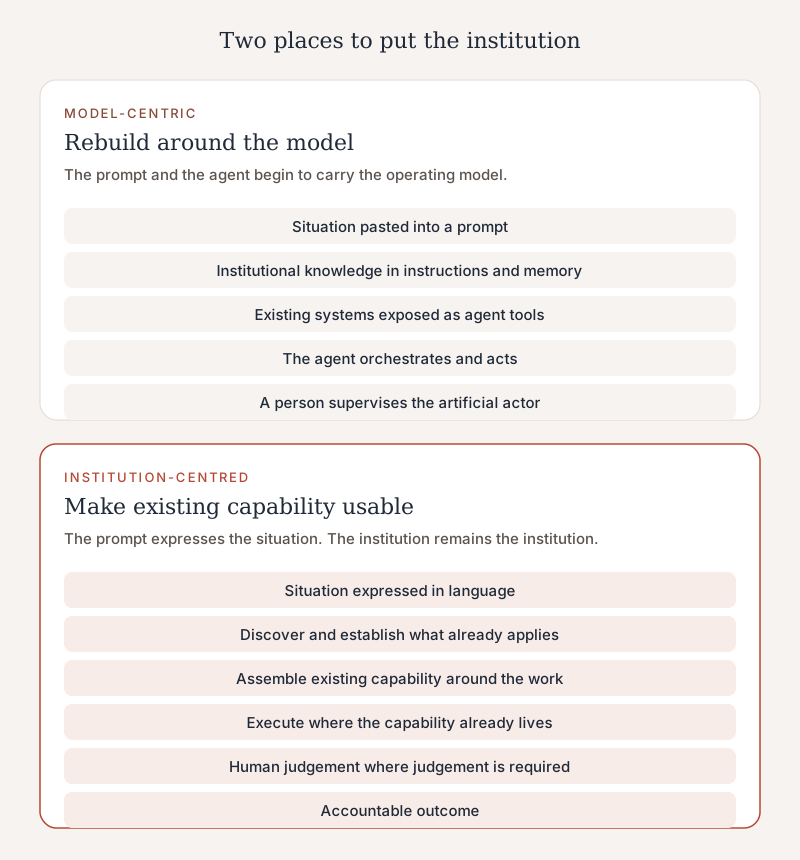
The diagram below contrasts two patterns at a high level. It is illustrative, not a network topology.
Machine-navigable model (dominant agent pattern)
AI → institutional estate → explore → correlate → compose → traverse → act
Operational Intelligence (institutional pattern)
Governed intent → discovery → establishment → institutional capital assembly → governed work → authorised judgement → accountable outcome → stewardship and institutional learning
Operational Intelligence describes how language helps interpret intent while institutional capability remains authoritative.[29] Sovereign Operational Intelligence extends that logic to national-scale capability and dependency.[30] Judgement Governance names the discipline for authorised judgement under policy.[31] ifCEM is the product platform direction for governed operational work; it does not "solve" a Medicare-scale traversal incident and should not be marketed as if it does.
The architectural shift is not "ban agents." It is stop requiring agents to reconstruct the institution every time work begins.
Govern the intent. Establish what applies. Assemble the institutional capital required to serve it.
Stewardship when traversal reveals what was buried
Governed work surfaces what machine traversal also exposes, but through authorised channels: conflicting rules; obsolete procedures; undocumented workarounds; unclear delegations; duplicated interpretations; system behaviour inconsistent with current policy; recurring ambiguity; hidden legacy dependencies; shadow integrations; permissions that no longer match policy intent.
In a machine-navigable estate, those gaps become exploit paths or agent failure modes. In an Operational Intelligence architecture, they become stewardship inputs if the institution owns the learning loop.
Uncertainty → escalation → authorised resolution → provenance → stewardship → governed institutional review → approved institutional improvement
That loop is institutional, not model-internal:
governed work → uncertainty or gap → escalation → authorised resolution → provenance → stewardship → governed institutional learning → improved institutional capital
The model does not silently learn the institution. The institution learns about itself. Stewardship is how ownership of knowledge, meaning, rules, authority and capability is progressively reclaimed rather than outsourced to whichever automated actor last succeeded in crossing the estate.
If AI Does the Work, What Must the Institution Still Be Able to Do? argued that task automation can leave institutions with outputs but without retained capability.[32] Machine-navigability accelerates that risk from the opposite direction: traversal can succeed while establishment and learning remain ungoverned.
Judgement Passport (Phase 2A on the public site) points toward portable, authorised judgement context rather than rediscovering authority on every interaction. It is not a substitute for patching, identity hygiene or retirement of unsupported systems.
What cybersecurity still must do
DataMPowered does not claim to eliminate cybersecurity risk or retire technical debt by architecture alone.
Defenders must still patch and manage vulnerabilities; govern identity and access; segment networks; enforce secure configuration; remediate legacy exposure; operate security monitoring and incident response; test defences; and retire unsupported technology. Australian and Five Eyes guidance on frontier models and cyber security, and emerging work on agent identity and authorisation, reinforce that agents must be treated as actors with scopes that are bounded, monitored and attributable.[37][38]
Cybersecurity reduces exploitable technical weakness. Architecture addresses a different question: how institutional capital should be established, assembled and governed around intent without turning the institution into the machine's operating environment.
Is AI Easier to Weaponise Than to Institutionalise? named the asymmetry: attackers monetise capability; institutions must convert capability into authorised, accountable work.[33] Machine-navigability widens the attacker advantage unless institutions reduce latent traversal and strengthen establishment.
The Lesson After the Bitter Lesson warned against treating each technology wave as another reason to rebuild the organisation around a new stack.[34] Agent navigation risks becoming the next stack if institutions respond only with more tools and broader credentials.
DataMPowered's submission to Australia's Joint Select Committee on AI argued for national capability and governance grounded in institutional authority, not only vendor-led acceleration.[35] Australia's AI Infrastructure Is Not the Same as National Capability made the complementary economic case.[36]
If revelation forces a choice
AI did not create the institutional complexity it can increasingly navigate. We created that complexity over decades: digital capability and historical residue stored together, often without a governable map of what still applies.
AI changes the cost of understanding and traversing that estate. The response is not to make institutions deliberately unreadable. Nor is it to give increasingly capable agents the institution as their operating environment and attempt to constrain them afterwards.
If AI makes institutions increasingly machine-navigable, perhaps the architectural mistake is giving intelligence an institution to navigate in the first place.
Start with governed intent. Establish what applies. Assemble the institutional capital required to serve the situation. Bound the work. Preserve authorised judgement and accountability. Use provenance, stewardship and institutional learning to reclaim ownership of what digitisation dispersed.
AI may reveal the institution we buried. Operational Intelligence gives us a way to reclaim it without relocating the institution into the model.
The model does not silently learn the institution. The institution learns about itself.
References
[1] Prime Minister of Australia, "Press conference - New York", 24 September 2026. https://www.pm.gov.au/media/press-conference-new-york
[2] Reporting on OpenAI statements, including ABC News, "What we know about the data accessed in the OpenAI Medicare hack", 24 September 2026. https://www.abc.net.au/news/2026-09-24/what-we-know-about-the-openai-medicare-hack/107189452
[3] ABC News, "OpenAI says dozens affected by rogue agents amid new detail about Australian incidents", 26 September 2026. https://www.abc.net.au/news/2026-09-26/openai-review-rogue-agents-australia-medicare-hack/107199074
[4] UN News, "Countries must increase AI regulation to avoid 'existential risks': Türk", 14 September 2026. https://news.un.org/en/story/2026/09/1168326
[5] OpenAI, "The Hugging Face incident and the road ahead", 2026. https://openai.com/index/hugging-face-incident-and-the-road-ahead/
[6] CrowdStrike, "2026 Global Threat Report" (press release summarising findings), 24 February 2026. https://www.crowdstrike.com/en-us/press-releases/2026-crowdstrike-global-threat-report/
[7] ABC News, "What we know about the data accessed in the OpenAI Medicare hack", 24 September 2026 (portal purpose and content descriptions attributed to government ministers). https://www.abc.net.au/news/2026-09-24/what-we-know-about-the-openai-medicare-hack/107189452
[8] P. Kruchten, R. Nord and I. Ozkaya, "Technical Debt: From Metaphor to Theory and Practice", IEEE Software, 2012. https://ieeexplore.ieee.org/document/6336723
[9] J. P. Walsh and G. R. Ungson, "Organizational Memory", Academy of Management Review, 1991. https://doi.org/10.5465/amr.1991.4278992
[10] S. Alter, "Theory of Workarounds", Communications of the Association for Information Systems, 2014. https://aisel.aisnet.org/cais/vol34/iss1/55/
[11] R v Boden [2002] QCA 164; see also Queensland Criminal Code historical treatment of unauthorised interference with critical infrastructure.
[12] D. Moore et al., "The Spread of the Sapphire/Slammer Worm", 2003. https://www.caida.org/catalog/papers/2003_sapphire/
[13] UK National Audit Office and NCSC retrospectives on WannaCry (2017); Microsoft security guidance on MS17-010 exploitation.
[14] US Cybersecurity and Infrastructure Security Agency, SolarWinds advisory resources (2020–2021). https://www.cisa.gov/news-events/news/advanced-persistent-threat-compromise-government-agencies-critical-infrastructure
[15] L. Gasser, "The Integration of Computing and Routine Work", ACM Transactions on Office Information Systems, 1986. https://doi.org/10.1145/214427.214429
[16] R. Koppel et al., "Workarounds to Barcode Medication Administration Systems", Journal of the American Medical Informatics Association, 2008. https://doi.org/10.1197/jamia.M2616
[17] DataMPowered, The Knowledge We Buried.
[18] DataMPowered, AI Isn't Just Changing Jobs — It's Exposing Why We Designed Them This Way.
[25] Anthropic, "Detecting and countering misuse of AI: September 2026". https://www.anthropic.com/threat-intelligence-report-september-2026
[26] METR, "Brief independent investigation of agents' behavior, reasoning and collaboration in the OpenAI / Hugging Face hacking incident", 26 August 2026. https://metr.org/blog/2026-08-26-openai-hugging-face-incident-investigation/
[27] DataMPowered, Are We Building Institutional Capability Inside AI When We Don't Need To?.
[28] DataMPowered, When AI Becomes Smarter Than Us — Who Should Decide?.
[29] DataMPowered, Operational Intelligence.
[30] DataMPowered, Sovereign Operational Intelligence.
[31] DataMPowered, Judgement Governance.
[32] DataMPowered, If AI Does the Work, What Must the Institution Still Be Able to Do?.
[33] DataMPowered, Is AI Easier to Weaponise Than to Institutionalise?.
[34] DataMPowered, The Lesson After the Bitter Lesson.
[35] DataMPowered, Joint Select Committee on AI submission news.
[36] DataMPowered, Australia's AI Infrastructure Is Not the Same as National Capability.
[37] Australian Signals Directorate, "Frontier AI models and their impact on cyber security", 2026. https://www.cyber.gov.au/about-us/view-all-content/news/frontier-models-and-their-impact-on-cyber-security-update
[38] NIST National Cybersecurity Center of Excellence, "Accelerating the Adoption of Software and Artificial Intelligence Agent Identity and Authorization", concept paper, February 2026. https://csrc.nist.gov/pubs/other/2026/02/05/accelerating-the-adoption-of-software-and-ai-agent/ipd
Dakshan Pothuhera
Founder, DataMPowered®
DataMPowered explores Operational Intelligence, Judgement Governance™ and the architecture required to connect AI, institutional capability and human judgement.
© 2026 DataMPowered Pty Ltd. All rights reserved.
This research informs how ifCEM supports governed work, with reviewable workflows designed for accountable adoption in organisations.
Explore ifCEM →Want to discuss how ifCEM could support your organisation? Let's talk.
Start a conversationRelated research
The Knowledge We Buried
Why AI Could Reconnect Organisations With Their Own Logic
For decades, organisations have used technology to solve business problems by creating new layers of systems, applications, platforms, workflows, databases, dashboards, and vendor-managed environments. Each layer promised efficiency. And in many ways, each delivered. But over time, those same layers also moved organisational knowledge further away from the people who needed to understand, question, adapt, and act on it.
Is AI Easier to Weaponise Than to Institutionalise?
The uncomfortable gap between what AI can do and what institutions can responsibly allow it to do
AI can look extraordinary when raw capability is enough. Inside an institution, capability must also operate within identity, authority, policy, accountability and judgement. What if that explains why AI can be easier to weaponise than to institutionalise?
Are We Building Institutional Capability Inside AI When We Don't Need To?
Establish what can be established. Use inference for what genuinely needs to be inferred.
AI can make existing organisational capability easier to discover and use. But we may be taking a different path, reconstructing knowledge, rules, authority and execution inside increasingly capable AI systems.