
DataMPowered submission published by Parliament's Joint Select Committee on Artificial Intelligence
DataMPowered's submission to the Australian Parliament's Joint Select Committee on Artificial Intelligence has been published as Submission 60, setting out a framework for productive and accountable AI centred on institutional capability, human authority and accountable work.
Publication of Submission 60
The Parliament of Australia has published a written submission from DataMPowered Pty Ltd to the Joint Select Committee on Artificial Intelligence as Submission 60. The published document is titled From AI Adoption to Institutional Capability: A framework for productive, accountable AI in Australia. DataMPowered lodged the submission on 7 September 2026. The full text is available from Parliament's document store (PDF).
Publication on the committee website records the submission as part of the inquiry record. It does not indicate that the committee or Parliament endorses DataMPowered's views. The committee was appointed on 20 August 2026 and is due to present its final report by 30 November 2026. Submissions to this inquiry are now closed.
The submission's central proposition is that Australia should govern high-stakes, AI-enabled decision-making and administrative workflows, rather than regulating external AI models alone. The objective, as stated in the submission, is to securely unlock institutional knowledge for public benefit while strengthening Australia's sovereign capability, by preserving human authority, verifiable evidence, contextual judgement and legal accountability that underpin legitimate institutional action.
The adoption problem is larger than the model
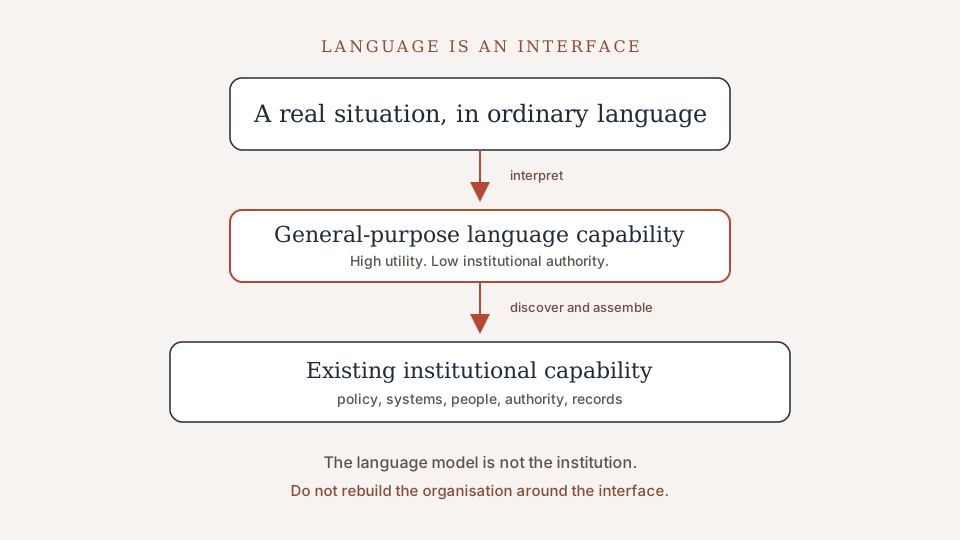
The submission argues that productivity and assurance depend on how institutions organise what they already hold. Policies, systems of record, business rules, data, services, specialist expertise, delegated authority, review mechanisms and operational teams already embody substantial capability. AI models are improving at interpreting language and synthesising information, but that does not mean a model should become the organising centre of an institution.
The practical challenge is to make existing capability easier to find and bring together around a person's situation, while keeping the controls that make institutional action legitimate. The submission describes a third path between slow, system-bound institutions on one hand and highly autonomous AI agents on the other: use AI where interpretation and synthesis are genuinely useful, while keeping authoritative facts, permissions, rules, execution controls and accountable decisions in governed institutional systems. Foundation models are characterised as powerful but replaceable reasoning tools within that environment—not as the source of institutional truth or authority.
Five operational distinctions
Section 3 of the submission sets out five distinctions intended as a practical grammar for operational AI governance:
Inference is not establishment. Models make inferences; institutions often need facts confirmed through trusted records, evidence or accountable processes. These should not be treated as the same thing.
Capability is not access. Identifying that a system, dataset, service or person could help does not mean someone is allowed to use it. Relevance is only the first question; permission is separate.
Access is not authority. Being able to see information or use a capability does not necessarily mean a person or system has the legal, financial or organisational authority to make a consequential decision.
Authority is not judgement. Someone may be authorised to act, but the situation may still require evaluation, discretion and reasons. A simple human approval click is not the same as meaningful judgement.
Automation is not delegation. Automating a step does not hand responsibility to the model. The institution remains accountable for how the process is designed, controlled and reviewed.
Seven recommendations
The submission's recommendations, numbered as lodged, are:
Govern consequential work, not only models. Commonwealth AI policy and guidance should address the full chain in which AI is used: intent, context, evidence, applicable rules, access, authority, human judgement, execution, outcomes and review.
Keep inference separate from institutional fact. AI-generated interpretation, prediction or synthesis should not quietly become authoritative institutional knowledge. Systems should show provenance and how important facts have been properly established.
Make institutional capability easier to discover in real situations. Encourage standards and reference patterns that make policies, services, APIs, data, workflows and accountable human roles visible through governed metadata and discovery mechanisms, without moving those assets into foundation models.
Separate capability, access, authority, execution and judgement. These are different control questions and should not be bundled into a single agent permission, broad system access setting or simple human-approval step.
Treat sovereign AI capability as institutional control, not just compute and models. Sovereignty should include control over authoritative knowledge, rules, context, evidence, access decisions, decision rights and audit records, and the practical ability to substitute models where possible.
Build reconstructability and contestability into consequential AI-enabled work. For important decisions and actions, institutions should be able to show what was known, what was inferred, which rules applied, who or what was authorised to act, where AI contributed, what judgement was applied, and how the outcome can be reviewed or challenged.
Use bounded public-sector exemplars to test the operating model. The Commonwealth should choose real service journeys where knowledge is spread across systems and teams, then test whether governed discovery and context assembly can improve service while preserving legal and accountability structures already in place.
Sovereign capability in the submission's terms
The submission welcomes focus on sovereign AI capability and data sovereignty, but argues that sovereignty is not only about where models are built or where data is stored. It is also about whether Australian institutions remain in control of the knowledge, rules and decisions that matter to them.
An institution is more resilient, in the submission's framing, when it keeps control of authoritative knowledge, policies, evidence, identity and access systems, delegated authority, decision records and review pathways, and can change or replace a foundation model without rebuilding institutional work around a new vendor. Sector-specific models may still matter, but their outputs should be used within a governed institutional setting—not treated as authoritative simply because of training location or sector data.
Proposed Commonwealth demonstration program
To test these ideas, the submission proposes that the Commonwealth run a small demonstration program across a few agencies. The focus should be real service journeys that are important but contained—not generic chatbots. Suitable examples involve useful knowledge spread across policies, systems, data sources and teams, where staff must manage access, authority and judgement carefully.
The program should measure more than speed: whether people can find the right information or service; whether hand-offs and search effort fall; whether assembled context is complete and traceable; whether access and authority limits are respected; how unresolved gaps are handled; whether human effort concentrates on genuine judgement; whether outcomes can be reconstructed; and whether users can understand or challenge a result. Lessons would inform reusable patterns for Commonwealth agencies and, where appropriate, industry adaptation—alongside work by the Australian AI Safety Institute and adoption guidance from the National AI Centre.
This is a policy recommendation to government. It is not a description of DataMPowered's commercial services or any particular vendor product.
Closing perspective
As models become more capable, the question is not only what AI can do. It is how institutions can use that capability while retaining control of what is established as true, what is authorised, what requires judgement, what may be acted on, and who remains accountable. Submission 60 argues that responsible design can support adoption, not only constrain it, when institutions keep knowledge, authority, resilience and public trust at the centre of how AI-enabled work is organised.
Continue exploring
Since the submission was prepared, DataMPowered has continued developing these ideas through its work on institutional capability, operational AI governance and sovereign operational capability.
Submission 60 reflects the terminology and recommendations lodged with the Committee on 7 September 2026. DataMPowered's current architecture pages show how related thinking has continued to develop since then. They do not replace or rewrite what was published in the parliamentary record.
Readers can explore:
Sovereign Operational Capability: institutional control, context and perimeter sovereignty in architecture terms.
Operational Intelligence: moving from human expression to accountable outcomes in governed institutional settings.
AI Governance & Assurance: governance and assurance work on consequential AI-enabled institutional processes.
Sources
DataMPowered Pty Ltd, From AI Adoption to Institutional Capability: A framework for productive, accountable AI in Australia, submission to the Joint Select Committee on Artificial Intelligence, 7 September 2026 (Parliament PDF; submissions listing).
Parliament of Australia, Joint Select Committee on Artificial Intelligence: inquiry page.
More News from Research
No other posts in this category yet.