Governance discipline

What is Judgement Governance™?

AI Governance asks whether the system is safe. Judgement Governance asks whether the human judgement stayed informed, visible and accountable.

Judgement Governance™ is a developing governance discipline. It is not yet available as a product capability in the ifCEM public pilot.

The problem

The missing layer

AI is becoming part of how work is produced, reviewed and decided.

It drafts emails. It summarises reports. It interprets data. It prepares recommendations. It turns conversations into actions.

Governance cannot stop at the model or the tool.

When AI influences real work, organisations also need to understand the judgement chain around that work.

Complementary disciplines

AI Governance vs Judgement Governance

AI Governance asks:

  • • Is the model approved?
  • • Is the system secure?
  • • Are policies enforced?
  • • Are risks monitored?
  • • Are outputs controlled?

Judgement Governance asks:

  • • Was the judgement informed?
  • • What evidence shaped it?
  • • What context was missing?
  • • What did AI contribute?
  • • What did the human accept, reject or change?
  • • What reasons supported the outcome?
  • • Who remains accountable?

These are complementary disciplines.

AI Governance manages the system.

Judgement Governance preserves accountability in the work.

Why now

Why it matters now

People rarely adopt AI to break rules.

They adopt it because work does not wait.

That means AI can enter workflows before leaders, risk teams or governance processes can see where it is being used.

The result is not always obvious failure.

The result is invisible influence: assumptions no one reviewed, wording no one owned, reasoning no one reconstructed, and decisions whose evidence trail is incomplete.

Accountable judgement

What Judgement Governance captures

A strong judgement trail should make visible:

  • Intent
  • Context
  • Evidence
  • Constraints
  • AI contribution
  • Human review
  • Discretion
  • Reasons
  • Decision owner
  • Outcome
  • Review history

This trail describes what accountable judgement requires. Individual elements may be recorded in Judgement Passports; the ecology across a matter is held by a Judgement Object.

Universal proposition

Outcomes vs the ecology of judgement

Most systems preserve outcomes.

Judgement Governance™ preserves the evolution and ecology of judgement.

That ecology includes:

  • why a judgement was formed;
  • what evidence it relied on;
  • what assumptions shaped it;
  • how it changed;
  • how it related to other judgements;
  • why the eventual outcome differed from earlier positions.

This is not an AI-specific claim. It applies wherever institutions must explain how judgement evolved — not only what was eventually decided.

Framework model

Judgement Object and Judgement Passport

Judgement Governance defines two complementary artefacts.

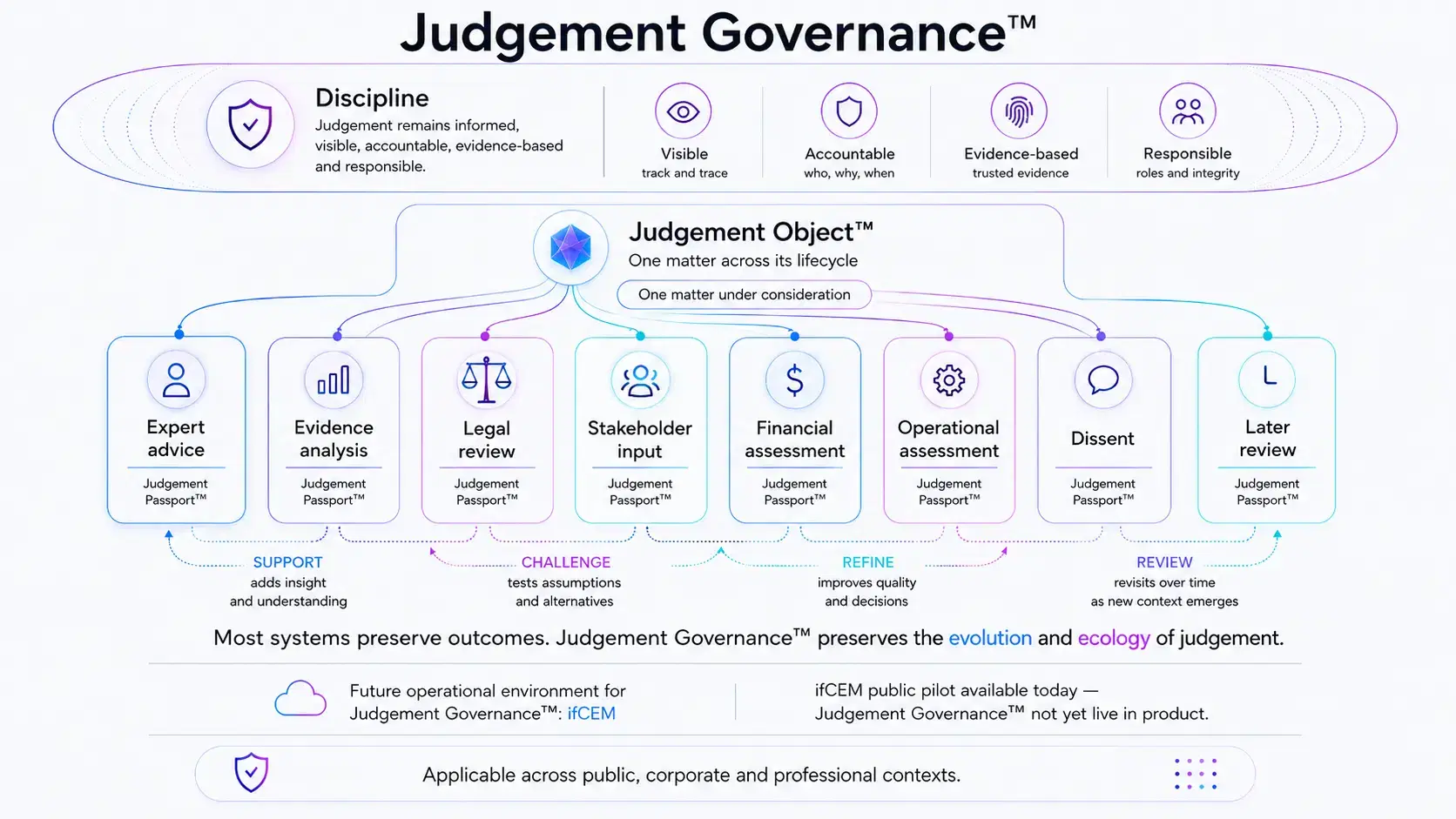
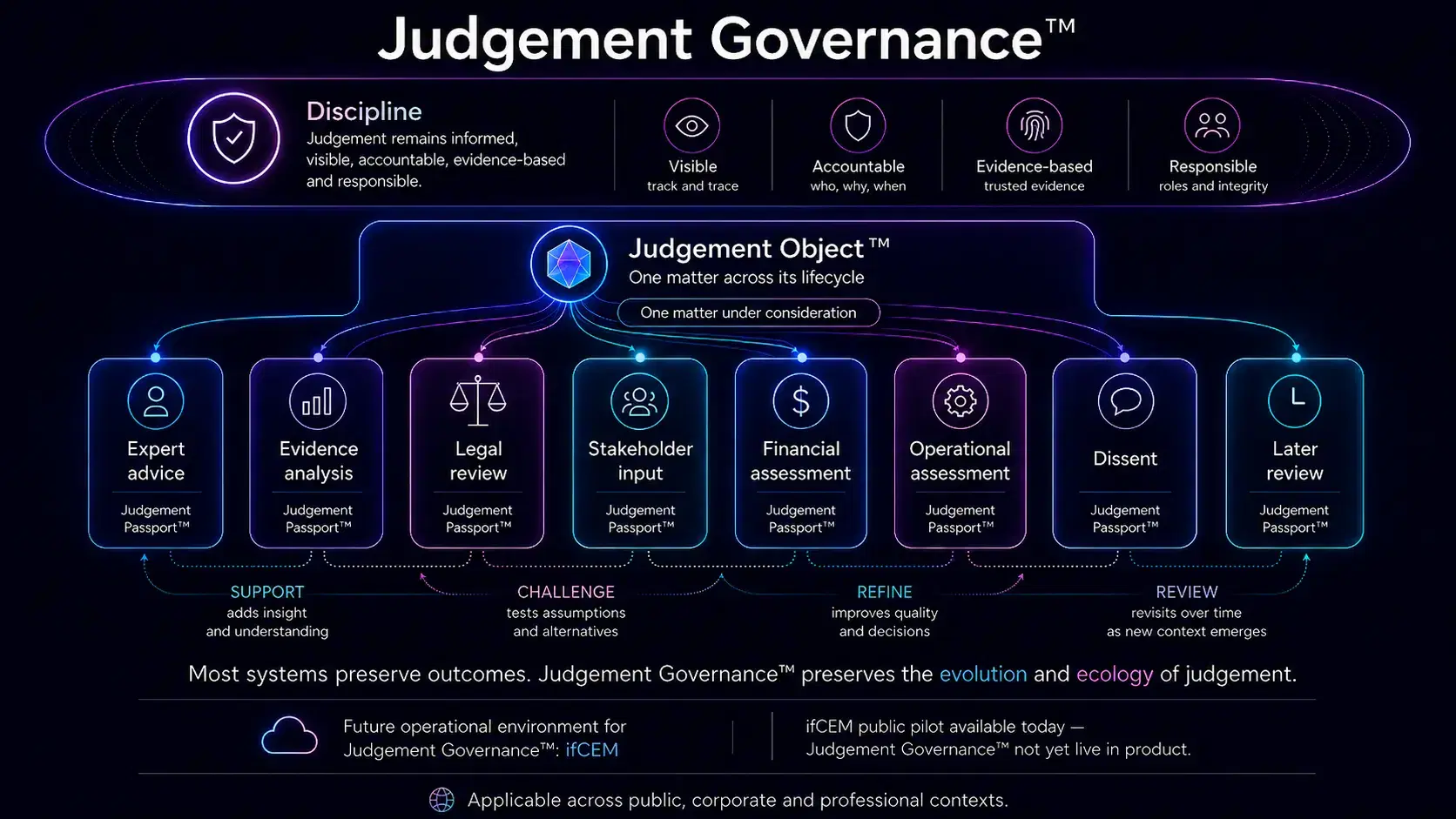
Judgement Governance framework relationship model. Judgement Governance is the discipline governing accountable judgement. One Judgement Object links many Judgement Passports across a matter. Each Passport records one judgement; Passports may support, challenge, refine, contradict or supersede one another. ifCEM is the future operational environment for the discipline.

Judgement Object™

The lifecycle container that links every Judgement Passport associated with a particular issue, proposal, policy, case, programme or decision.

The Object persists across the full lifecycle of the matter. Decisions and outcomes may result from the Object but are not the Object. Not every judgement within a matter must result in a formal decision — Passports may record review, dissent or synthesis that shape the ecology without a single decisive outcome.

Judgement Passport™

The provenance and accountability record for a single judgement.

Each Passport records how one distinct judgement was formed, reviewed and owned at a point in the work.

How they relate

  • One Judgement Object → many Judgement Passports
  • One Judgement Passport → one judgement

Passports within one Object may represent different roles, perspectives, disciplines, evidence streams, stages or reviews. Over time, Passports may support, challenge, refine, contradict or supersede one another.

Example

Judgement Object: Housing Affordability Reform 2028

Linked Passports may include expert advice, policy analysis, legal review, citizen input, financial assessment, dissent, synthesis and later review.

Discipline boundaries

Judgement Governance
The discipline — not a product feature.
Judgement Object
The lifecycle container — not a decision record.
Judgement Passport
The provenance record for one judgement — not a document dump or audit log.
ifCEM
Operational Intelligence pilot available today; possible future operational environment for the discipline — not Judgement Governance itself.

Platform relationship

How ifCEM relates to the discipline

ifCEM is the Operational Intelligence Platform through which Judgement Governance™ can be applied as the product matures.

It is publicly available as a pilot with free signup and a free plan that includes 50 credits. Today's pilot delivers governed capabilities including context, experience and modularity, a Personal Assistant, Supervisor governance, document and data workflows, explainability and related features.

Supervisor governance coordinates execution in the pilot. It is not the same as Judgement Governance™ — the discipline DataMPowered is building toward operational support for over time.

Judgement Governance™, Judgement Objects™ and Judgement Passports™ are not yet available as live product capabilities.

The goal is not to slow work down.

The goal is to make trusted AI easier to use than unmanaged AI.

Explore the ifCEM public pilot

Want to discuss how ifCEM could support your organisation? Let's talk.

Start a conversation