
Research
The Lesson After the Bitter Lesson
Regaining Organisational Control in the Age of Outcome-Driven AI
A response to the tension between messy organisational reality and outcome-driven AI, and why the next phase of adoption depends on an operational layer that restores visibility, governance, and accountability.
Editorial note (August 2026). This essay belongs to an earlier stage of DataMPowered's public language, including “governed AI workspaces.” The architectural position has since become more precise: the institution does not need to be recreated inside the model. See Operational Intelligence for the current operating model.
Introduction
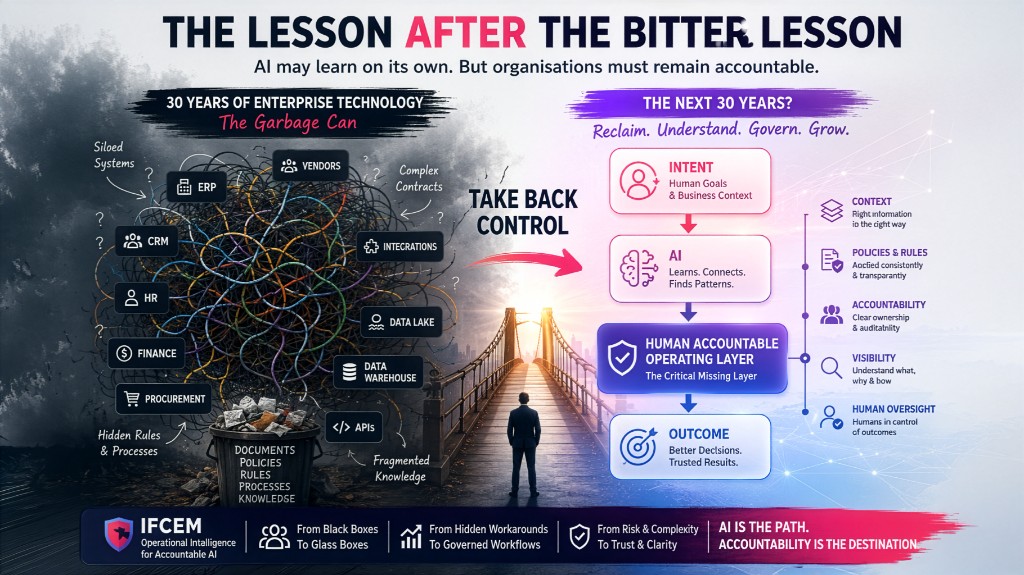
Ethan Mollick's recent article, The Bitter Lesson versus The Garbage Can [1], explores a fascinating tension. On one side sits the Garbage Can [4] view of organisations: messy systems, undocumented processes, unwritten rules, informal workarounds, and decisions that emerge from countless interactions between people, systems, and circumstances. On the other sits the Bitter Lesson [3] from AI research: that systems often outperform carefully engineered human knowledge by learning directly from outcomes through scale, computation, and reinforcement.
Many readers may conclude that organisations should simply let AI figure things out. I think the lesson is more nuanced. The future may belong to AI systems that focus on outcomes rather than explicit process design, but that does not mean organisations should abandon control. In fact, it may be the first opportunity they have had in decades to regain it.
How We Created the Garbage Can
For over two decades, organisations have adopted wave after wave of enterprise technology: ERP systems, CRM platforms, procurement systems, HR systems, cloud platforms, and industry-specific applications. Each promised standardisation, efficiency, and control, and many delivered tremendous value. But they also created an unintended consequence: the business gradually became separated from its own operational knowledge.
Policies became system configurations. Business rules became code. Process knowledge became vendor documentation. Organisational memory became scattered across applications, databases, contracts, consultants, and support teams. As each technology layer was added, understanding moved further away from the people doing the work. The business no longer interacted directly with its own logic; instead, it interacted with software interfaces.
To change a process often required:
- raising a support ticket
- engaging internal IT
- engaging an implementation partner
- engaging the software vendor
- navigating contractual constraints
- understanding technical dependencies
The organisation became increasingly dependent on the technology stack that was supposed to serve it. This was the central theme of an article I previously wrote titled Don't Boil the Ocean [2]. Each generation of technology solved one problem while introducing another layer of abstraction between people and the knowledge that governs their work.
When organisations later attempted to regain flexibility, they introduced additional layers:
- data warehouses and data lakes
- integration platforms
- master data solutions
- systems of record
- reporting environments
- process mining tools
Each was intended to reconnect fragmented knowledge. Yet many simply added another layer of complexity. The result is what many organisations experience today: a growing gap between how the business thinks it operates and how work actually gets done. In many ways, this is the Garbage Can [4] problem.
Why AI May Be Different
This is where I diverge from many governance discussions. I do not see AI primarily as a threat, I see it as a potential opportunity. For the first time, organisations have technology capable of interacting with information the way people do: not through rigid schemas, not through predefined workflows, not through fixed interfaces, but through intent.
A person can ask a question, explore a process, investigate a policy, understand a decision, and connect information across previously disconnected systems. The interaction becomes outcome-focused rather than system-focused. In many ways, AI may allow organisations to gradually reclaim access to the intellectual capital that has become trapped inside decades of enterprise technology: knowledge, policies, rules, procedures, operational history, decision rationale, and business context. These are the very assets that became increasingly difficult for business users to access directly.
The New Risk
However, this creates a new challenge. One of the biggest risks is treating AI adoption as just another technology transformation. Organisations have spent decades implementing new systems through familiar patterns: selecting platforms, redesigning processes, managing change programs, and integrating technology into existing operating models. AI is different. It does not simply automate a defined process or replace a legacy application. It changes how knowledge is accessed, how decisions are made, and how work itself is coordinated.
If organisations approach AI using the same assumptions that guided previous technology programs, they risk recreating the very problems that produced the Garbage Can [4] in the first place: new layers of tooling, new abstractions, new dependencies on vendors and specialists, and new forms of organisational distance from the knowledge that drives outcomes.
At the same time, if AI becomes the mechanism through which organisations interact with their operational knowledge, then visibility becomes more important, not less. The Bitter Lesson [3] suggests AI may discover its own path to successful outcomes, but organisations are not chess boards. Success is not simply producing the correct answer. Organisations also need to understand:
- What information was used?
- What assumptions were made?
- Which policies were applied?
- Who approved the decision?
- Who remains accountable?
An AI system may learn to produce outcomes without understanding human processes. The organisation cannot afford the same luxury.
The Missing Operating Layer
This is why I believe the next phase of AI adoption will not be defined solely by better models, larger context windows, or increasingly autonomous agents. It will be defined by the operational layer surrounding them, a layer that connects:
- human intent
- organisational knowledge
- business rules
- governance requirements
- accountability structures
while allowing AI systems to operate with increasing autonomy.
This is where IFCEM fits as a practical solution: an operational layer for accountable, governed AI that keeps decisions connected to context, policy, and oversight. Built by DataMPowered, IFCEM is designed to help organisations move beyond fragmented tools and towards auditable, outcome-focused AI execution.
The objective is not to constrain intelligence. It is to ensure that as organisations regain access to their intellectual capital, they do not lose visibility into how that capital is being used. The Bitter Lesson [3] may teach us that AI does not need to learn work the way humans do, but organisations will still need a way to understand, govern, and remain accountable for the work being done. That may be the lesson after the Bitter Lesson.
References
[1] E. Mollick, "The Bitter Lesson versus The Garbage Can," One Useful Thing, Jul. 2025. https://www.oneusefulthing.org/p/the-bitter-lesson-versus-the-garbage
[2] D. Pothuhera, "Don't Boil the Ocean," LinkedIn post, 2026. https://www.linkedin.com/posts/dakshan-pothuhera_businesstransformation-artificialintelligence-ugcPost-7469281156803252224-Aheu/
[3] R. Sutton, "The Bitter Lesson," Mar. 2019. https://www.cs.utexas.edu/~eunsol/courses/data/bitter_lesson.pdf
[4] M. D. Cohen, J. G. March, and J. P. Olsen, "A Garbage Can Model of Organizational Choice," Administrative Science Quarterly, vol. 17, no. 1, pp. 1–25, 1972. https://fbaum.unc.edu/teaching/articles/Cohen_March_Olsen_1972.pdf
This research informs how ifCEM supports governed work in the public pilot, with reviewable workflows designed for accountable adoption in organisations.
Explore the ifCEM public pilot →Want to discuss how ifCEM could support your organisation? Let's talk.
Start a conversationRelated research
Is AI Easier to Weaponise Than to Institutionalise?
The uncomfortable gap between what AI can do and what institutions can responsibly allow it to do
AI can look extraordinary when raw capability is enough. Inside an institution, capability must also operate within identity, authority, policy, accountability and judgement. What if that explains why AI can be easier to weaponise than to institutionalise?
When AI Becomes Smarter Than Us, Who Should Decide?
The distinction matters, because intelligence is only one part of the problem.
What exactly are we calling superintelligence, and why do we assume that becoming more intelligent should naturally mean acquiring more agency, authority and power? The distinction matters, because intelligence is only one part of the problem.
AI Isn’t Just Changing Jobs. It’s Exposing Why We Designed Them This Way.
Digitisation taught humans to translate intent into systems. AI is beginning to make that translation happen in real time. That may force us to rethink not only jobs, but applications, management, education, organisational knowledge and the skills we choose to build next.
Digitisation taught people to translate human intent into systems, applications and specialised processes. AI is beginning to collapse that translation layer. What does that mean for jobs, skills, management, education and institutional capability?