
Research · Essay
AI Isn’t Just Changing Jobs. It’s Exposing Why We Designed Them This Way.
Digitisation taught humans to translate intent into systems. AI is beginning to make that translation happen in real time. That may force us to rethink not only jobs, but applications, management, education, organisational knowledge and the skills we choose to build next.
Digitisation taught people to translate human intent into systems, applications and specialised processes. AI is beginning to collapse that translation layer. What does that mean for jobs, skills, management, education and institutional capability?
Much of the discussion about AI and work starts with a familiar question:
Which jobs will AI replace?
I think that question starts too late.
Before asking which jobs AI might change, we should ask why many jobs contain the activities they do in the first place.
For more than a century, technological progress has not simply given people better tools. It has changed how we organise work around the limitations and possibilities of those tools.
Industrialisation made it possible to decompose physical production into smaller, repeatable units. Scientific management [1] formalised that thinking. Frederick Taylor broke jobs into component activities, measured them and reconstructed work around efficiency and standardisation.
Digitisation continued the decomposition, but something different happened.
We began encoding knowledge, business rules, transactions and organisational capability into computers.
That delivered enormous gains in scale, speed and reliability.
But it also created distance between a person trying to achieve an outcome and the knowledge and resources required to achieve it.
And because the technology could not understand human intent, people had to learn how to translate between the human world and the digital one.
That translation became a surprisingly large part of modern knowledge work.
AI may now be changing the direction of that translation—toward language as an interface into institutional capability, under Sovereign Operational Intelligence.
And if it is, the implications go much further than automating tasks.
Digitisation did more than automate repetitive work
We often tell the history of digitisation as a productivity story. Paper became databases. Manual calculations became spreadsheets. Physical records became electronic records. Routine processes became automated workflows.
All of that happened.
But digitisation also changed the proximity of knowledge.
An organisation might know almost everything required to make a decision, while the person responsible for that decision could not access it directly.
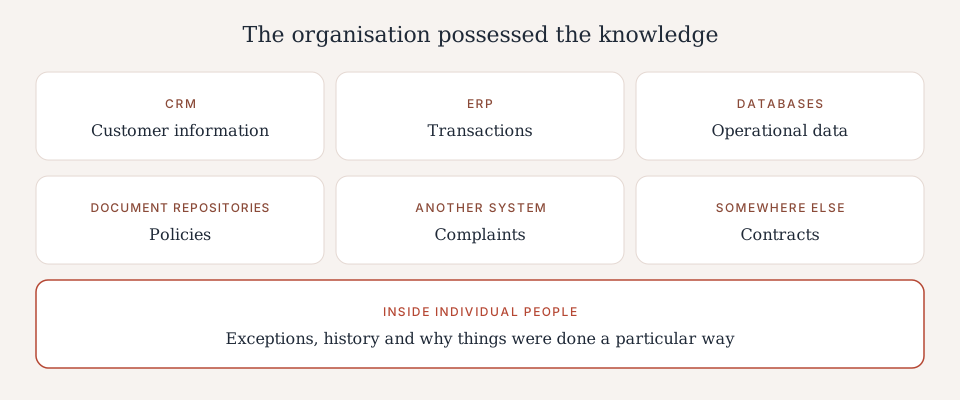
But reaching it required knowing where it was, how it was represented and which technical pathway would expose it.
That created another category of work.
Not simply repetitive work.
Translation work.
We built an enormous translation stack
If a manager had a question about the business, the question could not simply be handed to a database.
Someone had to translate it into SQL.
If information existed in different systems, it could not simply understand that two fields represented the same concept.
We built ETL [2] pipelines to extract, transform, reconcile and load it. ETL became foundational to combining information from disparate sources into forms that analytics systems could use.
Applications could not naturally understand one another.
We created APIs, middleware, integration platforms and message formats through which one technical representation could communicate with another.
Human policy could not simply become software behaviour.
We created requirements, decision tables, rules engines and configuration.
Human work itself could not simply be understood by computers.
We decomposed it into activities, conditions, roles, queues and workflow states. Business Process Management [3] formalised ways of coordinating people, systems and information through defined processes.
Even programming languages are part of this story. They progressively made machines easier for humans to direct, but people still had to convert human requirements into representations sufficiently formal for computers to execute.
At every stage, digitisation gave us more capability.
And at every stage, someone had to understand the new abstraction.
We created software engineers, database specialists, ETL developers, integration architects, system administrators, business analysts, application specialists, workflow designers, ERP consultants, reporting developers and countless other disciplines.
These were not unnecessary jobs.
They were essential to making the digital economy work.
But their existence also reveals something about the technological environment we created:
the machine could process capability, but it could not understand the human outcome that capability was meant to serve.
Humans supplied the translation.
Translation created another problem: coordination
As the technical estate grew, organisational capability became increasingly distributed.
Consider what sounds like a simple intention:
Allow customers to apply for this service online.
That might require expertise from product, business analysis, UX, software engineering, databases, integration, cybersecurity, identity, infrastructure, compliance, quality assurance, deployment, training and support.
Now somebody has to assemble those capabilities back around the outcome.
Translation takes time. Specialists have dependencies, teams have queues, resources have to be scheduled, requirements change, and someone has to know what is blocked and why.
So digitisation did not merely expand technical professions. It also expanded the organisational machinery required to coordinate them.
Projects, programs, PMOs, delivery management, process management, change management and substantial parts of middle management became mechanisms for maintaining coherence across fragmented capability.
Again, project management did not originate because of software, and management obviously predates digitisation.
The more defensible observation is that digital complexity increased the amount of coordination required to transform an organisational intention into a working outcome.
A large amount of modern management subsequently became information movement:
status meetings, progress reporting, resource allocation, escalation, dependency management, approvals, dashboard preparation and coordinating work between specialised functions.
Somebody had to keep an approximate picture of the whole because none of the systems could.
Then we had to assure the translations
There is another layer that is easy to overlook.
Every translation can lose meaning.
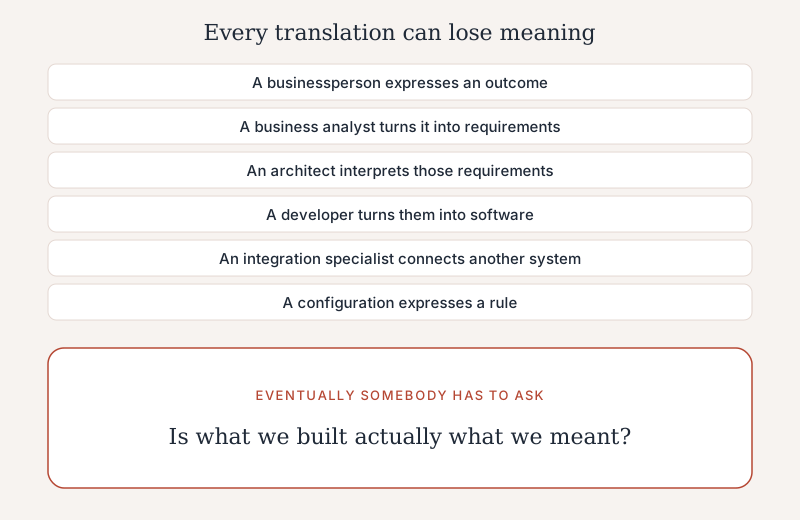
Quality assurance became partly a mechanism for finding errors in this chain.
Testing is not merely about catching software bugs. At a deeper level, it is about verifying whether the digital representation still produces the intended behaviour. Data quality addresses similar problems in translation between representations. Architecture tries to maintain coherence between systems. Audit reconstructs what happened afterwards. Governance asks a different question again.
Engineering might answer:
Can the system do this?
Governance has to answer:
Should it? Under what circumstances? Using whose authority? On what evidence? And who remains accountable?
The more powerful our digital capability became, the more surrounding disciplines were required to make its use reliable, safe and institutionally legitimate.
We eventually organised people around the applications
All of this influenced what a skilled worker looked like.
A good financial analyst did not only understand finance.
They learned spreadsheets, reporting systems, databases and whichever applications their organisation used.
A procurement professional learned commercial practice and the procurement platform.
A marketer learned the domain and the technology stack.
An administrator learned the organisation partly by learning which application, screen, code, form or workflow represented each kind of work.
We bundled two different kinds of expertise together:
domain expertise and interface expertise.
The latter became valuable because access to organisational capability required it.
The application became the organising container.
Software designers anticipated the things users might want to accomplish, encoded those possibilities into screens, menus, fields and workflows, and asked the human to learn that representation.
When the desired outcome did not fit the application, organisations created an enhancement, integration, workaround or another application.
The user adapted to the technology.
That was not necessarily poor design.
For most of the digital era, there was no practical alternative.
AI changes something more fundamental than productivity
A spreadsheet made arithmetic easier. Cloud computing abstracted physical infrastructure. Search made documents easier to find. APIs exposed functionality in standardised forms.
But users still generally had to understand the representation expected by the technology.
Generative AI introduces a different possibility.
Human language itself becomes an increasingly capable interface to digital capability.
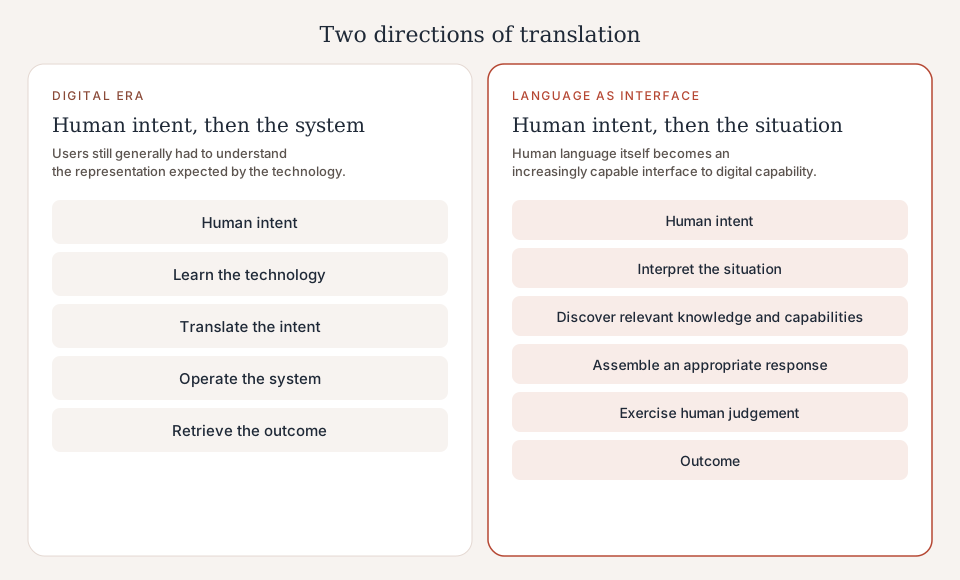
For much of the digital era, the direction was:
Human intent → learn the technology → translate the intent → operate the system → retrieve the outcome.
We can increasingly imagine:
Human intent → interpret the situation → discover relevant institutional knowledge and capabilities → assemble an appropriate response → exercise human judgement → outcome.
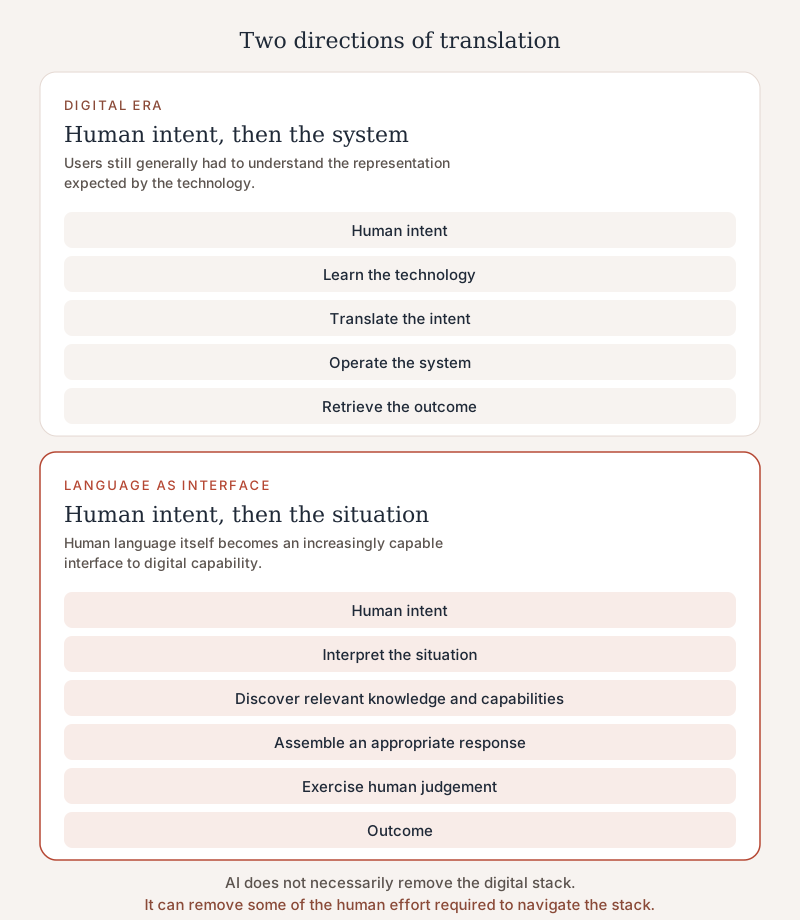
The underlying databases, APIs, deterministic software, infrastructure and physical systems do not disappear.
They may become even more important.
What changes is who needs to understand how all of them fit together.
AI does not necessarily remove the digital stack.
It can remove some of the human effort required to navigate the stack.
Perhaps the application is no longer the right organising unit
This raises a bigger architectural question.
Why should organisational capability necessarily be organised into fixed applications?
Consider procurement.
Today an application might bundle supplier management, purchasing, policy checks, approvals, contracts and reporting because someone pre-designed “procurement” as a software domain.
But from the organisation's perspective, the durable things may actually be capabilities.
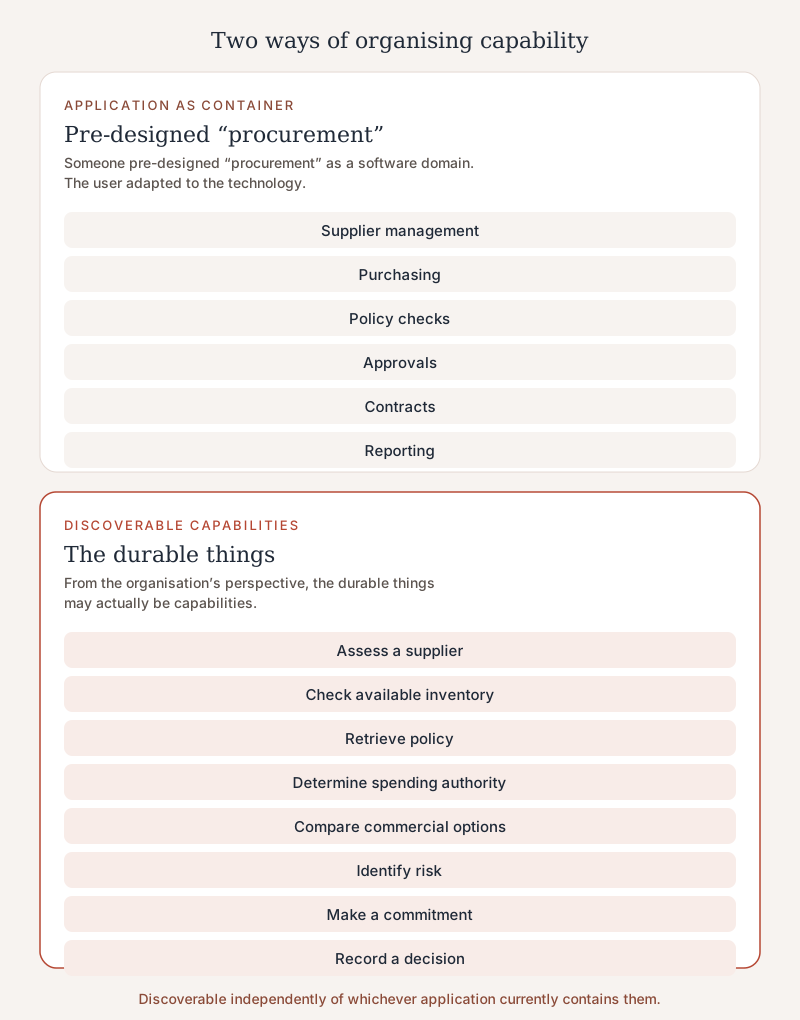
Those capabilities could be discoverable independently of whichever application currently contains them.
A person could express:
We need twenty laptops for new starters next month. Find the best compliant option within our budget.
The appropriate pathway might not even begin with procurement.
Perhaps another department already has twelve unused machines.
Perhaps a cyber policy restricts the hardware.
Perhaps a whole-of-organisation supplier agreement applies.
Perhaps the person asking does not hold sufficient authority.
A pre-designed workflow assumes the path before the situation exists.
A malleable environment can potentially determine the path from the intent, context, available capabilities, constraints and current situation.
That does not mean everything should be dynamic.
It means we need to distinguish what should be malleable from what should remain prescribed.
Intent, situations and events need different responses
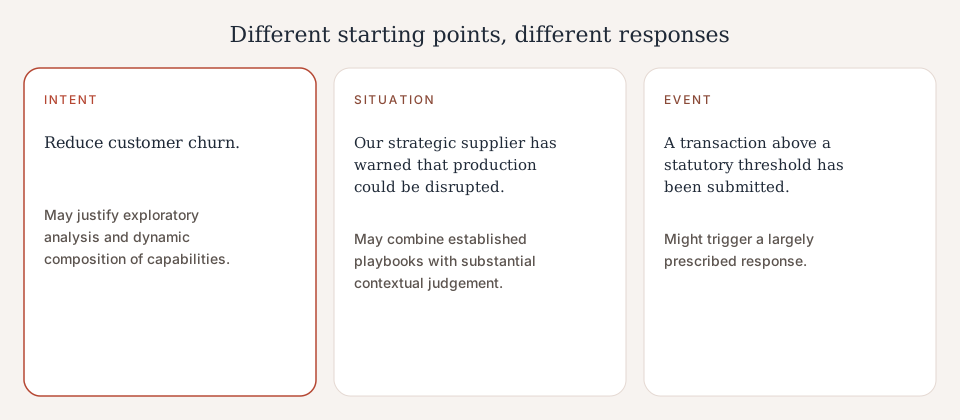
But even that distinction is not absolute.
A sudden 40% increase in customer complaints is an event, yet understanding its cause may require open-ended investigation.
So the important variables are not simply whether work begins with an intent or an event.
They include ambiguity, risk, available context and authority.
Malleability belongs where the institution has discretion over how an outcome is achieved.
Prescription belongs where the institution has already determined what must, must not or may only happen under defined conditions.
The route can be malleable.
The boundaries should remain explicit.
Real-time translation requires real-time judgement
This is where AI begins to challenge the organisational model surrounding digital work.
Traditional translation introduced latency.
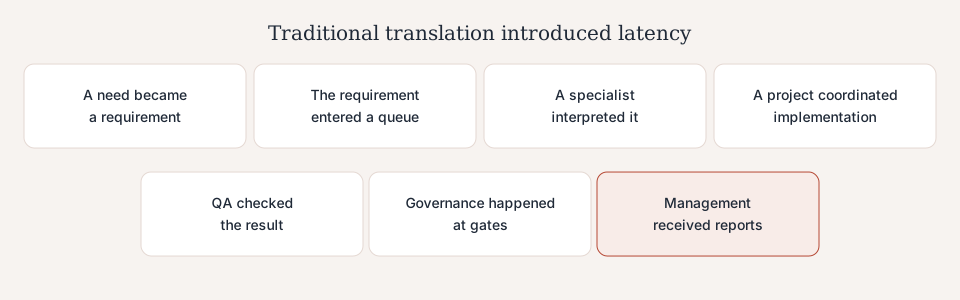
AI can compress large parts of that process.
If intent can be interpreted, knowledge retrieved, capabilities discovered and possible actions assembled almost immediately, then translation starts happening in real time.
That means assurance also needs to move closer to real time.
Governance needs to move closer to real time.
And crucially:
judgement needs to be exercised at the speed of operational intelligence.
That is not the same as saying humans must personally approve every machine action.
It means institutions need explicit ways to determine when something can proceed, when evidence is insufficient, when a boundary applies and when human authority is required.
This is why the future of work may depend as much on judgement and accountability as on model capability.
Some professional roles may move from translating rules to defining capabilities
This is where the implications for jobs become more interesting.
Consider a policy officer.
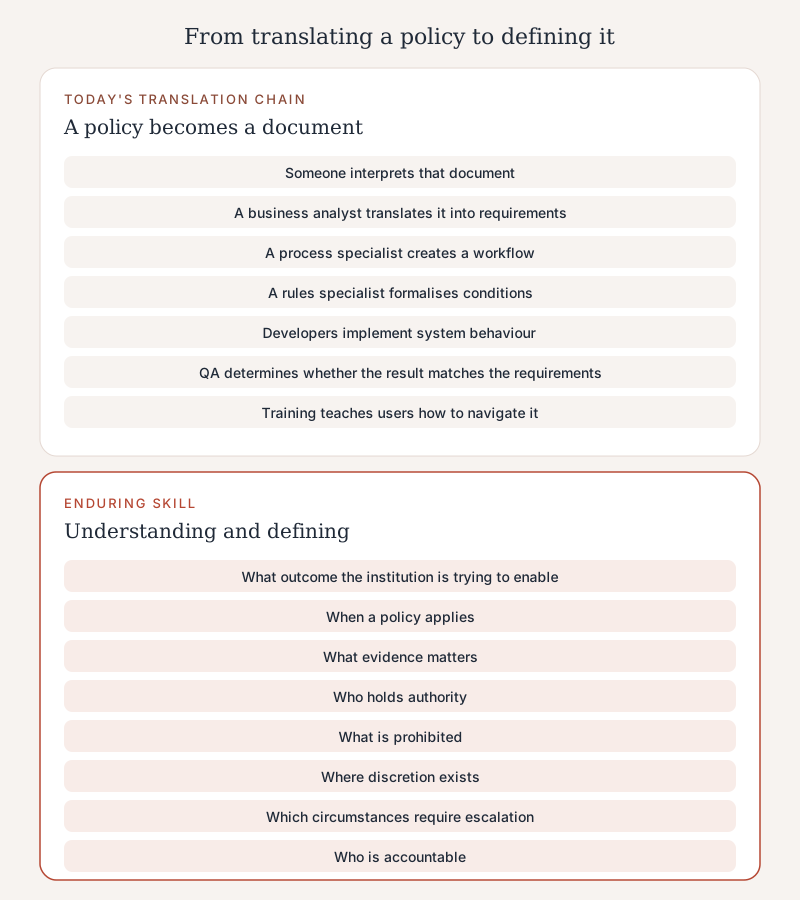
What if much of that translation chain collapses?
The enduring skill of the policy professional is not writing a PDF. In a more capable environment, that definition could increasingly become operational directly.
The policy officer would not necessarily become a programmer.
Instead, intelligent tooling could formalise the policy definition, connect it to existing capabilities, generate executable representations and continuously validate them against institutional boundaries.
The same shift could affect risk, legal, compliance, quality, finance and other domain professions.
Quality professionals could move further from executing repetitive test scripts toward defining what must remain true, what constitutes failure, what evidence is required and what uncertainty is acceptable.
Governance professionals could move from reviewing activity after implementation toward designing executable institutional boundaries.
Project managers could spend less time coordinating translation hand-offs and more time resolving genuine ambiguity, stakeholder conflict and consequential trade-offs.
And technologists would remain essential, but their centre of gravity could change too.
Deep specialists would still build foundational capabilities: secure infrastructure, networks, platforms, data foundations, advanced algorithms, cyber controls, robotics and difficult integrations.
But defining every new organisational capability might no longer require a chain of technical specialists to translate domain intent into scenario-specific software.
The deeper technical task becomes creating an environment in which trusted capability can be safely defined, discovered, composed and governed.
This changes how we think about domain expertise
AI does not make domain knowledge unimportant.
But it may change what part of domain knowledge is scarce.
Today domain expertise often includes knowing where the information is, which policy applies, which report contains it, how the system represents it, and which procedure normally follows.
If institutional knowledge is preserved properly and made accessible at the moment of need, some of that retrieval burden can move into the environment.
Research by Erik Brynjolfsson, Danielle Li and Lindsey Raymond [4] on 5,179 customer-support agents found that access to a generative AI assistant increased productivity by 14% on average and by 34% among novice and lower-skilled workers, with evidence that practices associated with stronger performers were being diffused to less experienced staff.
That does not eliminate expertise.
It shifts value toward knowing:
what the information means, whether it is appropriate to the situation and what should happen because of it.
The premium may gradually shift from possessing and retrieving knowledge toward interpreting and applying knowledge.
But this only works if organisations preserve institutional knowledge.
Otherwise AI simply creates faster access to fragmented information — or worse, moves organisational knowledge into proprietary tools that the institution does not truly control.
This is where sovereignty becomes a skills issue
There is a real danger that we recognise the old digital paradigm is changing and immediately reproduce it around AI.
We taught people to use applications.
Now we risk teaching everyone which model to choose, how to prompt, how to construct agents, how to configure agent frameworks, and how to operate whichever AI interface currently dominates.
There will absolutely be specialists who need those capabilities.
But they should not necessarily become the foundation of general workforce competence.
OECD research on AI and skills [5] points in the same direction: advanced AI-specific skills are concentrated in a relatively small share of the workforce, while broader capabilities such as interpreting information, problem-solving, creativity, innovation and managerial skills remain important across much more of the labour market.
If we centre broad workforce development around models and agents, we may repeat the same mistake made throughout the application era:
teach humans to organise themselves around the current technological abstraction.
There is another risk.
If organisational capability gradually becomes embedded in vendor-specific agents, proprietary prompts, model-specific memory and closed orchestration platforms, an organisation may appear increasingly AI-capable while becoming less sovereign.
We should therefore distinguish several forms of sovereignty.
Technology sovereignty asks who controls the infrastructure and models.
Knowledge sovereignty asks whether the institution retains its own history, policy, evidence, definitions, context and learning.
Capability sovereignty asks something more practical:
Can the institution continue to achieve an outcome if the underlying model, interface or vendor changes?
Models should be replaceable.
Agents should be replaceable.
Interfaces should evolve.
Institutional knowledge, authority and capability should remain.
If changing the model means relearning how the organisation works, the organisation never really owned the intelligence.
Education cannot simply bolt AI skills onto the digital-era model
This leaves education with a deeper challenge than teaching people how to use AI.
Australia's tertiary system is explicitly being asked to respond to the changing skills needs of the economy. The Australian Universities Accord [6] describes substantial growth in demand for tertiary-educated workers and a need for higher education and vocational education to respond to future skills requirements.
At the National AI Skills Forum [7] in Canberra in August 2026, Skills and Training Minister Andrew Giles made an important distinction: closing Australia's capability gap is “not simply a matter of teaching everyone to use the same tools.”
Different workers will need different capabilities. But every worker using AI needs to understand what it can do, its limits, when an output should be questioned, and whether an answer makes sense.
That distinction could become much more important than it initially appears.
For the digital economy, education understandably supplied increasingly specialised knowledge and capabilities into increasingly specialised roles.
But if human language becomes a more general interface to organisational capability, we should reconsider what deserves to sit at the centre of learning.
Not less knowledge.
Judgement without knowledge is dangerous.
Not less practice.
Experts develop judgement partly through doing.
But perhaps less emphasis on treating mastery of the current interface as the durable skill.
The OECD's 2026 Digital Education Outlook [8] warns that general-purpose generative AI can improve immediate task performance without necessarily producing learning gains when learners simply offload cognitive work. Used deliberately, however, it can support deeper learning, critical thinking, creativity and collaboration.
So the challenge is not to teach students how to avoid thinking because a machine now can.
It is to make them much better at the parts of work for which thinking matters.
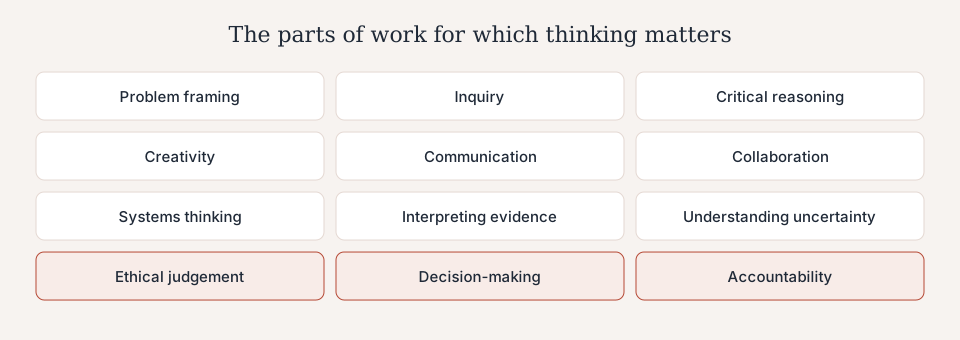
We traditionally call many of these soft skills.
That description may be becoming obsolete.
When an AI-mediated environment can turn an instruction into operational activity almost immediately, poor communication, weak judgement or an inability to detect uncertainty can produce very hard consequences.
The AI era may reveal that many of the skills we called soft were actually the hard part all along.
We may have mistaken the scaffolding for the job
The International Labour Organization's 2025 assessment [9] of nearly 30,000 tasks makes an important distinction. A significant share of workers are in occupations with some exposure to generative AI, but transformation is more likely than wholesale replacement because occupations generally contain tasks that continue to require human input.
That suggests another way to look at jobs.
Many modern roles may contain two layers that have become difficult to distinguish.
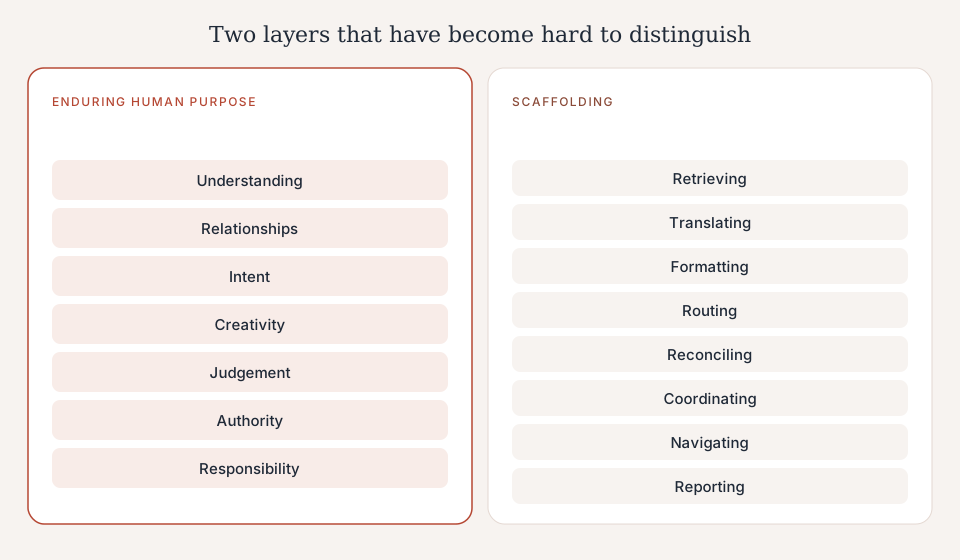
AI will not divide those categories neatly.
It will create new complexities and new technical work of its own.
But it may expose the distinction.
And that leads to a very different future-of-work conversation.
Instead of asking:
Which jobs can AI do?
we might ask:
Which parts of our jobs exist because previous technology could not understand what we were trying to achieve?
Instead of asking:
How do we train everyone to use AI?
we might ask:
How do we make institutional capability easier for people to direct through intent, knowledge and judgement?
Instead of building another generation of fixed AI applications and specialised agents for people to learn, we might focus on making organisational capability explicit, discoverable, malleable and governed.
Then intent can organise the work.
Situations and events can activate appropriate responses.
Institutional knowledge can provide context.
Capabilities can provide the means.
Policy and governance can define boundaries.
Human judgement can intervene where uncertainty, consequence or authority requires it.
And learning from the outcome can remain with the institution.
Industrialisation taught us to organise people around machinery.
Digitisation taught us to organise knowledge work around systems and applications.
We should be careful not to spend the AI era organising everyone around models and agents.
Perhaps AI isn't forcing us to redesign humans for the future of work.
Perhaps it is finally giving us the opportunity to redesign work — and the technology underneath it — around humans again.
That architectural shift is part of what ifCEM is designed to support in governed professional work.
References
[1] OpenStax, “Taylor-Made Management,” Principles of Management. https://openstax.org/books/principles-management/pages/3-4-taylor-made-management
[2] IBM, “What is ETL (Extract, Transform, Load)?” https://www.ibm.com/think/topics/etl
[3] IBM, “What is business process management (BPM)?” https://www.ibm.com/think/topics/business-process-management
[4] E. Brynjolfsson, D. Li, and L. Raymond, “Generative AI at Work,” NBER Working Paper 31161. https://www.nber.org/papers/w31161
[5] OECD, “AI and skills.” https://www.oecd.org/en/publications/ai-and-skills_f843b352-en.html
[6] Australian Government Department of Education, “Meeting Australia's Future Skills Needs,” Australian Universities Accord. https://www.education.gov.au/australian-universities-accord/resources/meeting-australias-future-skills-needs
[7] A. Giles, “National AI Skills Forum, Canberra,” 19 August 2026. https://ministers.dewr.gov.au/giles/national-ai-skills-forum-canberra?page=6
[8] OECD, “OECD Digital Education Outlook 2026.” https://www.oecd.org/en/publications/oecd-digital-education-outlook-2026_062a7394-en.html
[9] International Labour Organization, “Generative AI and Jobs: A 2025 Update.” https://www.ilo.org/publications/generative-ai-and-jobs-2025-update
This research informs how ifCEM supports governed work, with reviewable workflows designed for accountable adoption in organisations.
Explore ifCEM →Want to discuss how ifCEM could support your organisation? Let's talk.
Start a conversationRelated research
Information Rich, Judgement Poor
When cognition becomes cheap, what remains scarce?
When machine cognition becomes cheap, productivity depends on more than consuming more AI. This essay examines Australia's productivity puzzle, the economics of cheap cognition, institutional capability, judgement and the unfinished digital transformation.
Are We Transforming Around the Wrong Thing?
The opportunity may not be to rebuild organisations around AI, but to make institutional capability easier for people to discover, assemble and use.
We may be treating AI as another enterprise transformation. The opportunity may be a language interface into capability institutions already have.
If AI Does the Work, What Must the Institution Still Be Able to Do?
Task capability is not role substitutability. Reliability is not authority. And keeping the outputs is not keeping the capability.
AI can increasingly perform the observable tasks of a role while the institution quietly loses the capability the role carried. The more useful question is not which jobs AI will take, but what the institution must still be able to do for itself.