
Research · Essay
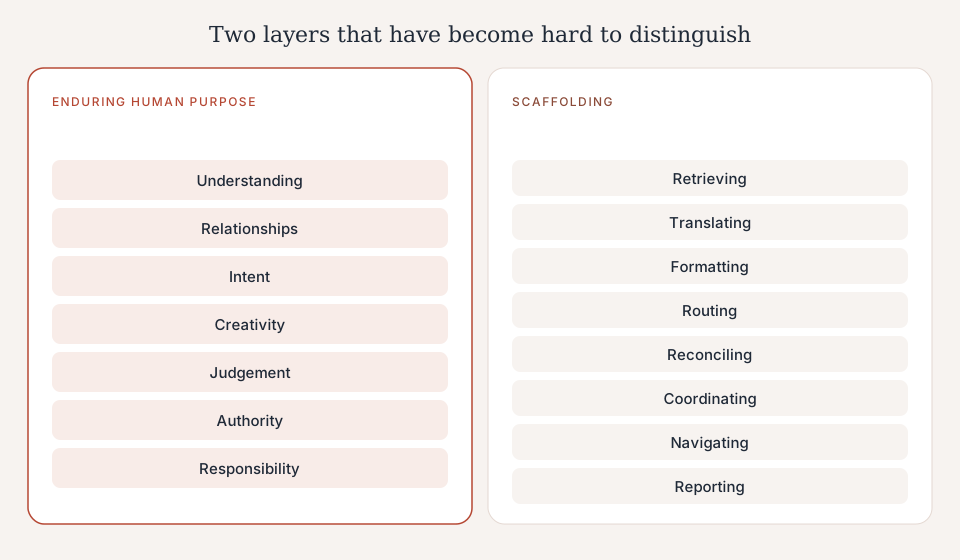
Information Rich, Judgement Poor
When cognition becomes cheap, what remains scarce?
When machine cognition becomes cheap, productivity depends on more than consuming more AI. This essay examines Australia's productivity puzzle, the economics of cheap cognition, institutional capability, judgement and the unfinished digital transformation.
Part I — The Productivity Paradox
For most of economic history, technological progress has been relatively
easy to understand.
A machine allowed one worker to produce what once required many. Steam
multiplied physical power. Electrification reorganised factories.
Mechanisation transformed agriculture. Containerisation changed the
economics of moving goods. The productivity logic was visible: more
output could be produced from fewer inputs.
The results accumulated over generations. The Productivity Commission
estimates that an Australian worker today can produce in roughly one
hour what took a worker an entire working day to produce in 1901.[1]
The digital revolution should, at first glance, have extended that
trajectory.
Computers became extraordinarily more powerful. Information that once
required filing rooms could be retrieved almost instantly. Communication
that took days became effectively free. Enterprise systems automated
accounting, payroll, inventory, procurement and countless other
functions. The internet removed distance from many forms of commerce.
Software became ubiquitous. Then infrastructure moved to the cloud and
sophisticated applications became available by subscription.
Few organisations today could operate without technologies that barely
existed a generation ago.
Yet Australia's productivity statistics tell a less spectacular story.
The Productivity Commission's latest estimates show whole-economy labour
productivity barely above its pre-pandemic 2015--19 average.[2] Over the
decade since June 2014, market-sector labour productivity increased by
about 7.5 per cent, while non-market productivity fell by around 2.5 per
cent. Whole-economy productivity increased only 3.6 per cent.[2]
The longer historical deterioration is harder to dismiss as a temporary
disruption. Reserve Bank analysis has estimated trend productivity
growth at around 0.7 per cent a year, well below rates achieved during
earlier periods of Australia's economic development.[3]
This produces an uncomfortable question.
If technology has made us so much more capable, why has that
capability become so difficult to see in productivity?
One tempting explanation is that Australia simply became a service
economy.
Services now dominate Australian employment and economic activity.
Services have also become increasingly important inputs into the
production of other services and goods. Between 1994--95 and 2017--18,
services increased from 72.8 per cent to 80 per cent of Australian
production. Their share of total intermediate inputs increased from 57.2
per cent to 71.2 per cent.[4]
Professional, scientific and technical services expanded. Computer
systems design expanded. Administrative services expanded. Organisations
increasingly purchased capabilities from specialists that they once
might have maintained internally.
It is easy to construct a compelling story from those numbers.
Perhaps modern organisations simply became too complicated.
More systems required more specialists. More specialists required more
coordination. More outsourcing required more contracts and vendor
management. More information required more analysts. Digitalisation
might have increased capability while simultaneously creating an
expanding organisational apparatus required to hold everything together.
It is an attractive explanation.
The problem is that the evidence does not cooperate.
When the growth in services' share of Australian intermediate inputs is
compared with market-sector multifactor productivity over their common
period, the relationship is weak.[19] A superficially interesting nonlinear
relationship also disappears once the passage of time is controlled for.[19]
More damaging to the simple complexity argument, the total amount of
intermediate input required for each unit of Australian output did not
rise.
It fell.
The total intermediate-use-to-output ratio declined from about 0.55 in
the mid-1990s to around 0.50 by 2020--21.[20] The equivalent ratio for
service industries also declined.[20]
The economy was using a greater proportion of services among its
intermediate inputs without requiring an ever-increasing quantity of
intermediate resources for every unit of output.
Something more interesting had happened.
The composition of production was changing.
The firm began to dissolve at its edges
The digital revolution did more than automate existing work.
It changed where work could be performed.
When communication was expensive and information moved slowly,
organisations had strong reasons to keep capabilities together.
Accounting departments, computing infrastructure, administration,
engineering support and many other functions lived within the
organisational boundary partly because coordinating them externally was
difficult.
Digital communication progressively reduced that constraint.
Activities could be separated.
Specialist providers could perform them at scale. Work could be
contracted to another organisation or moved offshore. Businesses could
concentrate on what they considered their core expertise while buying
other capabilities from increasingly sophisticated markets.
Australia's economic statistics record this transformation.
The ABS has noted that activities once performed within
firms---including accounting, computing, cleaning and administrative
functions---were increasingly contracted to specialised service
providers.[4] The change could improve efficiency: specialist providers
could achieve economies of scale, supply scarce expertise and reduce the
cost of ancillary activities.
This distinction matters.
An increase in the measured service economy did not always mean that
society was performing more administrative work. Sometimes the same
activity had simply crossed a corporate boundary.
A programmer employed by a bank contributes to the banking industry's
production.
Move that programmer to a technology consultancy selling the same
capability back to the bank and measured economic structure changes,
even though the underlying capability may be remarkably similar.
Outsourcing therefore complicates simple productivity narratives.
And during its earlier expansion, specialisation appears to have been
highly productive.
Australia's supply chains lengthened substantially during the 1990s as
firms reorganised production and relied more heavily on specialist
suppliers.[6] That period also coincided with unusually strong productivity
growth.[6] Reserve Bank research has argued that outsourcing and
organisational restructuring could improve resource allocation by
allowing firms to focus on comparative advantage and suppliers to
exploit scale.[6]
Offshoring extended the same principle geographically.
Digital work no longer had to occur in the same building, city or
country. Design, software development, administration and other business
services could increasingly be supplied internationally. International
research has even found positive productivity effects from service
offshoring in some industries.[7]
The evidence therefore gives us another warning against an easy
conclusion.
Specialisation was not necessarily the disease. It was itself an
innovation.
Technology made specialisation affordable.
And for a considerable period, that appears to have made organisations
more productive.
But it also began a deeper transformation that would become much more
important with the arrival of cloud computing.
Organisations were learning that they did not necessarily need to own
a capability in order to use it.
From owning technology to consuming capability
Early enterprise computing looked much like conventional industrial
capital.
An organisation bought computers.
It bought servers.
It acquired software licences.
It employed people to operate them.
Technology appeared on the balance sheet as productive capital in a form
economists could reasonably recognise.
Cloud computing began to alter that relationship.
Infrastructure as a Service meant an organisation no longer necessarily
needed to own the computing infrastructure.
Platform as a Service meant it could rent much of the environment
required to build and operate applications.
Software as a Service meant it could consume application capability
through a subscription.
The transformation can be described simply:
ownership became access.
And Australian statistics show the transition clearly.
Internet services accounted for only 0.2 per cent of total Australian
intermediate use in 1994--95. By 2017--18 the share had risen to 1.4 per
cent.[4] In dollar terms, intermediate use of internet services increased
from about $1.2 billion to more than $25 billion.[4] The ABS specifically
identifies the rapid growth from around 2010--11 with the emergence of
cloud computing and Software as a Service.[4]
Business adoption followed rapidly. Paid cloud computing went from a
minority activity to mainstream infrastructure, with adoption
particularly high among larger businesses.[4]
This creates an important problem when thinking about digital
productivity.
An organisation might once have increased its productive computing
capability by buying another server.
That looked like investment.
Today it might obtain vastly more capability by increasing its cloud
subscription.
That looks like an operating expense.
The Reserve Bank has explicitly cautioned that conventional measures of
technology investment do not capture all technology expenditure because
technology is increasingly purchased through subscriptions such as SaaS,
which appear as operating expenses.[8] Complementary expenditure on
retraining, organisational redesign and new processes can be even harder
to observe.
So the productive digital capability available to an organisation
increasingly looks less like:
Digital Capability = ICT Capital
and more like:
Digital Capability = Owned Technology + Purchased Digital Services + Software + Organisational Capability
This doesn't mean productivity statistics are wrong.
It means the architecture of production changed.
Capability crossed accounting boundaries.
It crossed organisational boundaries.
Sometimes it crossed national boundaries.
The digital economy was becoming an economy in which organisations
increasingly consumed productive capability rather than owned all of
the means required to produce it.
That transformation matters enormously for what came next.
But it also conceals an unfinished piece of the digital revolution.
We digitised the institution we already had
Digital transformation is often described as though organisations were
rebuilt by technology.
Many were not.
They were digitised.
The distinction matters.
A paper form became an electronic form.
A filing cabinet became a database.
A counter service became a website.
A letter became an email.
A manual calculation became an application.
A departmental process became a workflow.
Each change could produce real benefits. Taken together, they
transformed modern institutions.
But the underlying architecture often survived.
Departments remained departments.
Policies accumulated.
Applications accumulated.
Databases accumulated.
Organisational boundaries remained.
Specialist languages developed around each system and profession.
New technology connected what previous technology had separated.
Integration itself became a discipline.
Data had been digitised, but understanding where it lived, who
controlled it and how it related to everything else became increasingly
specialised work.
The paradox is subtle.
We digitised knowledge partly to make it accessible.
Over time, much of that knowledge became distributed across the systems,
databases, documents, organisational structures and specialist languages
we built to contain it.
Modern institutions therefore possess extraordinary capability.
The problem is often finding it.
A citizen does not necessarily know which department owns the capability
required to achieve an outcome.
An employee may not know which application, policy, dataset, API or
specialist team contains the answer to what they are trying to do.
Even the institution itself can struggle to see its capabilities as a
coherent whole.
This is not evidence that digitalisation failed.
Quite the opposite.
It is partly the consequence of decades of successful innovation
accumulating into institutional architecture.
But it suggests that digital transformation may have unfinished
business.
And just as that problem was becoming increasingly apparent, another
technology arrived.
This one did not merely make information cheaper.
It began making parts of cognition cheap.
Part II — When Cognition Became Cheap
Cloud computing changed the economics of computing.
Generative AI may be changing the economics of cognition.
That distinction matters.
For most of modern organisational history, many forms of cognitive work
were expensive because they required human time. Reading a document,
comparing alternatives, producing a first draft, translating material,
analysing data, writing software or synthesising information consumed
hours of skilled labour.
Computing automated parts of that work, but generally required us to
describe the task in terms the machine could execute. Software was
powerful precisely because someone had already translated a problem into
rules, data structures, interfaces and code.
Generative AI altered that relationship.
Increasingly, a person can describe what they are trying to achieve in
ordinary language and ask a model to perform a cognitive transformation
directly.
Interpret this.
Summarise this.
Compare these.
Find the pattern.
Explain this.
Translate this.
Draft this.
Write the code.
Suggest alternatives.
The model does not possess human cognition in some general sense, and
cognition should not be confused with judgement. But a growing range of
activities that previously required relatively expensive human cognitive
effort can now be performed, or at least assisted, by machines.
And their price is falling remarkably quickly.
Stanford's AI Index estimated that the inference cost of achieving
performance roughly equivalent to GPT-3.5 on one widely used benchmark
fell from approximately $20 per million tokens in November 2022 to
about seven cents by October 2024.[9]
That is a decline of more than 280-fold in less than two years.[9] Across
different tasks, Stanford found inference costs falling at rates ranging
from roughly ninefold to more than 900-fold a year.[9]
Models also became smaller and more efficient. The smallest model
exceeding a given performance threshold on one benchmark fell from
hundreds of billions of parameters in 2022 to 3.8 billion parameters two
years later.[10]
Something that had been expensive was becoming cheap.
It is tempting to jump immediately to the productivity conclusion.
If cognition becomes cheaper, cognitive work should become cheaper. If
cognitive work becomes cheaper, organisations should require fewer
resources to produce the same outcomes.
Sometimes that will undoubtedly happen.
But there is another possibility.
We may not consume the same amount of cognition.
We may consume vastly more of it.
The token is getting cheaper. The token bill may not be.
This is where the economics of generative AI become more interesting
than the price of a model.
The relevant equation is not particularly complicated:
AI Expenditure = Price of Cognitive Processing × Quantity Consumed
A hundredfold fall in unit price produces an enormous saving if
consumption remains constant.
But consumption rarely remains constant when a useful capability becomes
dramatically cheaper.
This is a familiar economic phenomenon.
Efficiency can reduce the cost of using a resource, making uses that
were previously uneconomic suddenly worthwhile. Consumption expands. In
sufficiently strong cases, the increase in demand can offset some, or
even all, of the savings created by the efficiency improvement.
The idea is often associated with the rebound effect and, in its
stronger form, the Jevons paradox.
There are early signs of exactly this dynamic in machine cognition.
Large-scale AI routing platforms have recorded enormous increases in
token volumes.[11] Enterprise spending on generative AI infrastructure and
model APIs has continued to grow even as quality-adjusted inference
prices have fallen.[12] Recent production data similarly show token
consumption continuing to expand rapidly.[11]
The evidence is not yet sufficient to declare an economy-wide Jevons
paradox for AI. The market is too young, and a token in one model or
workload is not economically identical to a token in another.
But the direction is increasingly difficult to ignore:
the cost of a unit of machine cognition is falling while the quantity
of machine cognition being consumed is rising dramatically.
And generative AI contains characteristics that could make this rebound
unusually powerful.
One more spin
There is something almost slot-machine-like about the economics.
Not because using AI is gambling, but because the marginal act of
consumption is so easy.
One more spin costs very little.
So does:
one more answer,
one more draft,
one more analysis,
one more critique,
one more scenario,
one more attempt,
one more search,
one more generated alternative.
When cognition was expensive because it required human labour,
organisations rationed it.
A senior analyst could not produce fifty alternative analyses merely
because someone was curious.
A software team could not rewrite an application ten different ways
before lunch.
A policy team could not ask twenty specialists independently to examine
every minor question.
Human cognitive capacity imposed a natural constraint.
Machine cognition weakens that constraint.
The immediate productivity gain is obvious: something that once took an
hour might take a minute.
But once the cost falls sufficiently, the question changes from:
How much cognition do we need?
to:
What else could we ask it to do?
That distinction becomes more important as models begin to reason for
longer before answering.
The advertised price of a token does not necessarily tell us the cost of
completing a useful task. Different models can consume radically
different quantities of reasoning tokens while pursuing the same
outcome. Research comparing reasoning models has found cases where a
model with a lower listed token price ultimately costs more to complete
a task because it consumes substantially more tokens while reasoning.[13]
The unit became cheaper.
The machine simply consumed more units.
Then the machine began spending the tokens
Agents take the phenomenon another step.
With a conventional chatbot, the relationship between human intent and
machine consumption remains relatively visible.
A person asks.
A model responds.
Agentic systems can break that relationship.
A person provides an objective.
The system might then:
interpret the objective,
construct a plan,
search for information,
invoke a tool,
inspect the result,
reason again,
call another service,
generate something,
test it,
identify a failure,
retry,
ask another model,
verify the result,
and continue until some completion condition is reached.
One human request can therefore become many machine cognitive
operations.
The economically important transformation is:
1 Human Intent `\neq 1` Inference
Increasingly:
1 Human Intent → N Machine Cognitive Operations
At that point the consumer is no longer making every incremental
decision to consume cognition.
Software is consuming cognition on behalf of software.
Industry forecasts consequently anticipate enormous increases in token
consumption as agents become more widely deployed.[14] Those forecasts
should be treated as forecasts, not facts. But they expose the economic
mechanism clearly: autonomy can multiply inference consumption even when
the number of human requests does not increase proportionately.
This suggests that the economics of AI should not be evaluated simply by
asking how cheap a million tokens have become.
The more useful question is:
How much machine cognition is consumed to produce a useful
outcome?
And ultimately:
How much useful outcome is produced for the total resources
consumed?
That is a productivity question.
Tokens themselves are not productivity.
They are an input.
Cheap cognition may still be concentrated cognition
There is another apparent contradiction.
The price of machine cognition is collapsing.
Yet producing it at the frontier is becoming extraordinarily capital
intensive.
These two things can coexist.
Indeed, economics gives us good reasons to expect them to.
AI infrastructure involves enormous fixed costs: advanced
semiconductors, data centres, energy, networking, model training,
specialised engineering and increasingly large capital programs.
Once that infrastructure exists, however, the marginal cost of producing
another unit of inference can become very small.
The result is an unusual production structure:
Fixed Cost ↑↑
while:
Marginal Cost ↓↓
That creates powerful economies of scale.
Current market evidence reflects this tension.
Competition between foundation models remains surprisingly dynamic.
Model leadership changes, new developers have reached the quality-price
frontier, open-weight models have improved, and quality-adjusted
inference prices continue to fall.
The infrastructure underneath them is considerably more concentrated.
Recent OECD analysis reports that three major providers accounted for
roughly three-quarters of the global cloud market in the figures it
examined, while NVIDIA held an overwhelming share of the GPU market.[15]
The Australian market is similarly concentrated. ACCC analysis citing
Gartner estimated that Microsoft, Amazon and Google together accounted
for more than four-fifths of Australian infrastructure-as-a-service
revenue in 2023.[16]
So the emerging economy need not choose between:
cheap cognition
and:
concentrated cognition.
It can have both.
That may be the more important possibility.
Cheap tokens, expensive dependency
A concentrated market does not need to make each unit expensive in order
to become economically powerful.
Quite the opposite may occur.
Imagine cognition becomes extraordinarily cheap.
Organisations rationally use more of it.
Software is redesigned around it.
Employees become accustomed to it.
Applications begin expecting it.
Processes incorporate it.
Agents invoke it automatically.
Eventually, the organisation's operating model assumes that machine
cognition is continuously available.
The price of an individual token might continue falling throughout this
process.
But something else has increased:
dependency.
And dependency does not reside only in the model.
It can accumulate across:
cloud infrastructure,
identity,
data platforms,
model interfaces,
agent frameworks,
proprietary tools,
application ecosystems,
and the integrations connecting them.
Competition authorities are already examining the potential for
switching costs, bundling, vertical integration and cloud market power
to influence emerging AI markets.
The risk is therefore more subtle than:
Big Technology will eventually make tokens expensive.
It might instead be:
Machine cognition becomes so cheap and useful that institutions
progressively redesign themselves around consuming it.
The token remains cheap.
Changing the architecture surrounding it does not.
Cheap tokens can coexist with expensive dependency.
But dependency is not the only question
There is a more immediate productivity issue.
Suppose an employee previously spent three hours preparing an analysis.
AI reduces the work required to fifteen minutes.
That creates an enormous potential productivity gain.
But what happens to the remaining two hours and forty-five minutes?
Perhaps the employee performs other valuable work.
Then productivity can rise.
But perhaps the new process becomes:
produce the analysis,
ask for five alternatives,
compare them,
generate three scenarios,
request a critique,
produce a longer version,
create an executive summary,
generate presentation slides,
run another analysis,
and verify all of it.
Three hours are still consumed.
The organisation now possesses vastly more cognitive output.
But has it produced a proportionately better outcome?
Not necessarily.
This distinction matters because AI can make production of cognitive
material extraordinarily cheap without making the organisational
capacity to use that material equally abundant.
A hundred analyses are not inherently more valuable than ten.
A thousand recommendations are not inherently more useful than one.
More code does not necessarily mean better software.
More policy options do not necessarily produce better policy.
More information does not automatically create more knowledge.
And more cognition does not automatically produce better judgement.
Information Rich, Judgement Poor
This is where the productivity question becomes an institutional one.
Generative AI can expand the supply of:
analysis,
interpretation,
recommendations,
drafts,
predictions,
code,
alternatives,
explanations,
and increasingly complex chains of machine reasoning.
But several things do not automatically scale with it:
attention
authority
accountability
trust
and:
judgement.
Someone still has to determine what matters.
Someone has to decide whether evidence is sufficient.
Someone has to reconcile competing objectives.
Someone has to understand which rules apply.
Someone has to decide when an exception is justified.
Someone has to possess authority to act.
And someone remains accountable for what happens.
These are not simply harder versions of text generation.
They are embedded in institutional context.
A model may produce an excellent recommendation without possessing the
authority to make the decision.
It may interpret a policy without owning the policy.
It may identify a course of action without bearing responsibility for
its consequences.
It may generate alternatives indefinitely without knowing when an
institution has enough information to act.
This suggests that AI may be changing the relative scarcity of different
productive capabilities.
For two centuries, technology progressively made previously scarce
things abundant.
Industrialisation made physical power cheaper.
Computing made information processing cheaper.
The internet made information distribution cheaper.
Cloud made computing capability available on demand.
Generative AI is now making significant forms of cognitive processing
cheaper.
Each transition moves the constraint.
If the production of cognitive material becomes abundant, then the
scarce resource may increasingly be the capacity to determine:
what should be done.
That is judgement.
Cognition is not judgement
This distinction is particularly important because the two are easily
conflated.
Models can perform increasingly impressive cognitive operations.
That is precisely why they are economically important.
But institutional judgement involves more than cognitive competence.
It exists within a structure of:
purpose,
rules,
authority,
precedent,
risk,
values,
responsibility,
and consequences.
The distinction can be expressed simply.
AI might help answer:
What does this situation appear to mean?
Judgement asks:
Given what this institution is responsible for, what should we do?
AI might identify:
These are the relevant options.
Judgement asks:
Which option should this institution authorise, and who has the
right to make that decision?
AI might conclude:
The evidence favours this interpretation.
Judgement asks:
Is the evidence sufficient to exercise institutional authority?
Models can certainly assist those questions.
They may eventually become extraordinarily good at assisting them.
But assistance does not erase the institutional structure in which the
decision acquires legitimacy.
This is why making cognition cheap does not make judgement cheap in the
same way.
The scarcity has moved.
The next productivity paradox
And that creates a new version of the puzzle with which we began.
The first digital productivity paradox asked:
Why did enormous increases in computing capability not always appear
as equally enormous increases in measured productivity?
The emerging AI version may be:
What happens when the production of cognitive output becomes almost
unconstrained, but the institutional capacity to absorb, evaluate and
act upon it does not?
One possibility is extraordinary productivity.
Another is extraordinary production of things that somebody must
subsequently read, verify, reconcile, govern and decide upon.
And there is a third possibility.
Faced with that mismatch, institutions may try to solve it by placing
progressively more of the institution itself inside the AI system.
Not only drafting.
Not only analysis.
But:
knowledge,
rules,
processes,
workflow,
decision logic,
coordination,
and eventually substantial parts of institutional capability.
That could appear to solve the bottleneck.
The model no longer merely produces information.
It begins operating the institution around it.
But that raises a much larger question.
If institutions spent the digital era progressively consuming externally
supplied computing and software capability, what happens when they begin
consuming institutional cognition and operational capability the
same way?
That is where the economics of cheap cognition collide with the
unfinished business of digital transformation.
And it is where we need to distinguish two very different futures:
building institutional capability inside AI
and:
using AI to build, discover and improve capability that remains with
the institution.
Part III — Build With AI, Not Inside It
If cognition becomes cheap, the obvious response is to use more of it.
For individuals, that is already happening.
For institutions, the consequences are more complicated.
A business or government agency cannot normally take a model response
and convert it directly into an institutional outcome. Institutions have
obligations that individuals do not. They operate through rules,
permissions, records, systems, delegations, policies, controls and
people with defined responsibilities.
A model may understand a request.
That does not mean it can authorise it.
A model may interpret a policy.
That does not make its interpretation the policy.
A model may recommend a payment.
That does not give it authority to spend public or corporate money.
A model may appear to make a reasonable decision.
That does not establish who is accountable for the decision.
Turning increasingly capable models into dependable institutional
machinery therefore requires considerably more than inference.
Around the model we increasingly construct:
data pipelines,
retrieval systems,
integrations,
agent frameworks,
tools,
identity controls,
permissions,
guardrails,
evaluation systems,
monitoring,
audit trails,
human-review processes,
and governance.
The model itself may become cheaper while the institutional architecture
required to make its output dependable becomes more elaborate.
The relevant economic equation is therefore not simply:
AI Cost = Tokens × Price
It is closer to:
Institutional AI Cost = Inference + Integration + Verification + Governance + Coordination + Dependency
The first term is falling dramatically.
There is no reason to assume that all the others are.
And this creates a temptation that deserves more attention.
Instead of using AI as another capability available to the institution,
we can progressively begin rebuilding the institution around AI.
When assistance becomes architecture
The transition need not be deliberate.
It can happen one useful application at a time.
First, a model helps employees find information.
Then retrieval is added so it can access organisational documents.
Tools are added so it can interact with systems.
Business rules are described so it knows what should happen.
Agents are introduced so it can coordinate multiple tasks.
Workflows begin to depend upon those agents.
Exceptions are encoded into orchestration.
Human approval is inserted where required.
Evaluation and monitoring are added to make the system dependable.
Each step may be perfectly rational.
Taken individually, each may improve productivity.
But eventually something important can change.
The model is no longer simply using institutional capability.
Increasingly, institutional capability is being constructed around the
model.
Knowledge begins to reside in retrieval architectures.
Process knowledge migrates into agent instructions.
Rules appear in prompts.
Coordination moves into orchestration frameworks.
Operational behaviour becomes dependent upon model characteristics.
And because much of the infrastructure may be supplied externally, an
institution can progressively move not only technology but also parts of
its practical capability beyond its organisational boundary.
This is not merely another version of data sovereignty.
It is a question of institutional capability sovereignty.
Sovereignty is more than where the server sits
The discussion of sovereign AI frequently begins with location.
Where is the model hosted?
Where is the data stored?
Which jurisdiction governs the infrastructure?
Those are important questions.
But they are not sufficient.
An institution could operate a model entirely within its own
jurisdiction and still become deeply dependent upon it.
The more fundamental question is:
Where does the capability of the institution actually reside?
Consider an institution whose authority formally remains unchanged but
whose ability to exercise that authority increasingly depends upon:
a proprietary model,
a particular cloud platform,
vendor-specific orchestration,
externally configured workflows,
consultant-maintained prompts,
proprietary data structures,
and specialist knowledge of how all those components interact.
The institution may still legally own the function.
Operationally, however, its capacity to exercise that function
independently may have weakened.
The test is surprisingly simple:
If the model disappeared tomorrow, would the institution still
possess the capability?
If replacing the model requires rebuilding how the institution works,
then something more important than a technology dependency may have
developed.
Capability itself has begun to migrate.
This matters particularly for government, but it is not exclusively a
public-sector problem.
Banks, insurers, universities, hospitals and major corporations also
possess institutional knowledge, rules, authorities and responsibilities
that should not be confused with the technology used to exercise them.
The model should be able to change.
The institution should remain.
This does not mean institutions should preserve what they have
There is an obvious danger in this argument.
If institutional capability should remain with the institution, it might
sound as though existing systems, processes and organisational
structures should simply be protected from AI.
That would be the wrong conclusion.
Much of the digital estate is overdue for transformation.
Legacy applications remain.
Manual processes remain.
Information is re-keyed between systems.
PDF forms become emails.
Spreadsheets bridge applications that were never integrated.
Business rules are duplicated.
Approval processes survive long after the reason for them has
disappeared.
People learn which system contains which fragment of information because
the institution itself provides no coherent way to discover it.
Specialist teams spend significant effort translating between
organisational boundaries.
Some of these arrangements exist for good reasons.
Others exist because yesterday's solution became today's architecture.
Preserving all of that in the name of institutional sovereignty would
merely preserve inefficiency.
The distinction we need is not:
existing technology versus AI.
It is:
institutional capability versus the technology through which that
capability is currently delivered.
A thirty-year-old application can disappear without the institution
surrendering the capability it performs.
Its data can move to an authoritative registry.
Its calculations can become a reusable service.
Its rules can become explicitly governed rules.
Its workflow can be redesigned.
Its interfaces can become APIs.
Its unnecessary steps can be removed entirely.
The technology changes.
The institution retains control of the capability.
That is digital transformation.
And there is a great deal of it still to do.
The unfinished digital transformation
The first digital transformation was enormously successful.
But much of it followed the organisational structure that already
existed.
We digitised forms.
We digitised records.
We digitised departmental processes.
We digitised individual services.
We connected applications.
We created websites through which people could reach them.
What we did not necessarily do was reorganise the institution around
what the person was actually trying to achieve.
That distinction becomes increasingly important.
A person rarely thinks:
I need to invoke application 14, obtain information from database 7
and then submit workflow B to department C.
They think:
I need to achieve something.
The institution then has to translate that intent into its own
architecture.
That translation has historically been performed through:
websites,
forms,
menus,
call centres,
case workers,
business analysts,
specialists,
service directories,
organisational knowledge,
and sometimes sheer persistence.
The institution possesses the capability.
The person has to discover how the institution has chosen to organise
it.
Generative AI creates an opportunity to reverse that relationship.
From systems to intent
Language models are unusually good at something traditional enterprise
systems are not.
They can work with ambiguity.
A person can explain a situation without knowing the institutional
vocabulary required to describe it.
The model can help interpret:
What is this person actually trying to achieve?
What information is relevant?
What appears to be missing?
What institutional capability might be required?
That does not require the model to become the capability.
Instead, it can help discover capability that already exists.
The architecture changes from something like:
Person
→ find the right organisation
→ find the right service
→ understand its terminology
→ find the right form
→ supply information in the required structure
→ move between systems and departments
toward:
Human intent
→ interpretation
→ capability discovery
→ appropriate institutional capabilities
→ authorised work
→ judgement where required
→ outcome.
The model's role can be substantial.
But it remains bounded.
It can interpret language.
It can help resolve ambiguity.
It can identify candidate capabilities.
It can prepare information.
It can explain outcomes.
It can assist people exercising judgement.
But the institution's:
rules,
data,
services,
registries,
calculations,
workflows,
delegations,
records,
and authorities
do not need to be recreated inside the model.
They can remain durable institutional capabilities that models discover
and use.
That makes the model powerful.
It also makes the model replaceable.
Discovery before replacement
This produces another productivity opportunity that is easy to overlook.
Suppose someone expresses a relatively simple intent:
I need to onboard this supplier and make the first payment.
The institution discovers that accomplishing it currently requires:
a PDF form,
an email,
manual data entry,
a procurement application,
a spreadsheet,
an approval email,
a finance application,
another manual check,
and finally a payment system.
AI could be trained or orchestrated to navigate all of those steps.
That might appear impressive.
It may even save time.
But it would also risk automating an architecture that should perhaps
not exist.
A different approach is to ask:
Why does satisfying this intent require all of these steps?
Perhaps the PDF should disappear.
Perhaps information should only be entered once.
Perhaps supplier validation should be a reusable capability.
Perhaps the financial threshold should be an explicit rule.
Perhaps approval should be triggered only when authority genuinely
requires it.
Perhaps the payment system should be invoked through an interface rather
than navigated.
Perhaps three applications are performing fragments of what should be
one coherent institutional capability.
AI has not necessarily solved the problem.
It has helped us see it.
This is where capability discovery becomes a mechanism for
transformation.
Three different productivity gains
This distinction matters because the current discussion often attributes
almost any improvement occurring near AI to "AI productivity".
There are at least three different mechanisms.
Cognitive productivity
AI reduces the human effort required for activities such as
interpretation, drafting, analysis, coding and synthesis.
This is the most obvious productivity effect.
Discovery productivity
People and systems spend less effort finding, understanding and
coordinating institutional capability.
The gain comes from reducing:
search,
translation,
navigation,
handoffs,
and coordination.
AI may make this possible, but the capability being used already
existed.
Transformation productivity
Making capability visible exposes processes and systems that can be:
removed,
simplified,
integrated,
digitised,
automated,
or redesigned.
The resulting productivity improvement comes from changing the
institution itself.
These gains should not be conflated.
If AI identifies a seventeen-step process and an institution redesigns
it into five steps, it would be misleading to attribute the enduring
gain entirely to generative AI.
AI may have been the instrument of discovery.
The productivity gain came from eliminating twelve unnecessary steps.
That is digital transformation.
And it remains unfinished.
AI can make finishing it cheaper
This is where cheap cognition may have one of its most important
effects.
AI does not have to replace institutional capability to transform its
economics.
It can dramatically reduce the cost of building better capability.
Software development is an obvious example.
AI can assist with:
understanding legacy code,
writing new code,
generating tests,
documenting systems,
identifying dependencies,
creating interfaces,
analysing requirements,
migrating applications,
mapping data,
and exploring alternative designs.
The same principle can extend beyond coding.
AI can help analyse processes, compare policy documents, identify
duplicated requirements, extract business rules, document institutional
knowledge and expose inconsistencies.
The important distinction is what remains when the AI interaction ends.
One approach produces:
Intent → Tokens → Outcome
The next outcome requires more tokens.
And the next.
And the next.
The alternative uses cheap cognition as an input into building something
durable:
Tokens → Better Capability → Repeated Outcomes
The AI may disappear from the production path altogether once the
capability has been built.
Or it may remain as a replaceable component where machine cognition is
genuinely useful.
Either way, the enduring asset is the institutional capability, not
the model conversation that created it.
This gives us an important principle:
Build capability with AI. Do not build institutional capability
inside AI.
The difference is economic, not merely architectural
This distinction also reconnects with the transition from capital
expenditure to operating expenditure.
Cloud and SaaS taught organisations that they could consume capabilities
rather than own the infrastructure underneath them.
That produced enormous benefits.
Generative AI could extend that logic much further.
An organisation might increasingly consume:
analysis as a service,
coding as a service,
research as a service,
decision support as a service,
workflow execution as a service,
and eventually substantial portions of operational cognition as a
service.
There is nothing inherently wrong with purchasing any of those
capabilities.
Specialisation has repeatedly increased productivity.
The problem arises if consuming external capability progressively
removes the institution's capacity to operate independently.
Then the economic calculation cannot be reduced to:
Is the API cheaper than the employee?
It also has to ask:
What capability is the institution accumulating---or ceasing to
accumulate---as a consequence?
That question is largely absent from conventional AI productivity
calculations.
From digital sovereignty to capability sovereignty
This gives sovereignty a broader meaning.
Sovereignty does not require an institution to manufacture its own
processors.
It does not require it to build its own foundation model.
It does not require every application to be developed internally.
And it certainly does not require rejecting cloud computing.
An institution can rely on external technology while remaining sovereign
over what matters.
The crucial distinction is whether it retains control over:
its knowledge
its rules
its institutional capabilities
its authority
its records
its judgement
and its practical ability to change the technologies supporting them.
This suggests another useful test.
Not:
Can we replace this model?
but:
Can we replace this model without reconstructing the institution?
That is a much higher standard.
And it provides a practical definition of institutional capability
sovereignty:
Technology can change without requiring the institution to
rediscover how to be itself.
The alternative is not less AI
This point is important.
Nothing in this argument requires cautious or minimal adoption of AI.
The opposite may be true.
Institutions could use far more AI than they do today:
to write software,
modernise legacy systems,
understand documents,
make capabilities discoverable,
reduce administrative friction,
help people express intent,
prepare work,
identify transformation opportunities,
and support institutional judgement.
The distinction is where the resulting capability resides.
AI should be free to contribute cognition.
It should be free to help construct capability.
It should be replaceable when something better appears.
What should not happen accidentally is for the institution's knowledge
of how to function to migrate progressively into an external cognitive
infrastructure simply because that infrastructure was initially cheap
and convenient.
The history we examined in Part I should make us particularly alert to
this possibility.
Outsourcing moved activities across organisational boundaries.
Cloud moved computing infrastructure across them.
SaaS moved application capability across them.
Generative AI now creates the possibility of moving cognitive and
operational capability across them.
Each transition can be productive.
The question is not whether the boundary should ever move.
It is whether we understand what crossed it.
What should remain scarce?
We can now return to the question with which this essay began.
When cognition becomes cheap, what remains scarce?
Part II suggested one answer:
judgement.
But Part III suggests another.
Institutional capability.
Not applications.
Not servers.
Not prompts.
Not models.
Capability is the accumulated ability of an institution to achieve
something reliably within its purpose, rules and authority.
Technology can make that capability cheaper to build.
AI can make it easier to discover.
Digital transformation can make it simpler.
External providers can contribute components to it.
But the institution must still know what it is capable of doing, under
what authority, using what rules, with what evidence and with whom
accountable for the outcome.
That is what gives machine cognition institutional meaning.
Without it, cheap cognition can simply produce more.
More information.
More recommendations.
More software.
More agents.
More activity.
More tokens.
With it, cheap cognition can do something much more consequential.
It can help institutions finally address the unfinished work of the
digital era: make the capabilities they have accumulated discoverable
from the perspective of human intent, remove the processes that no
longer deserve to exist, and make the capabilities that remain
dramatically cheaper to improve.
That may ultimately prove to be a larger productivity opportunity than
automating cognitive work itself.
Because the objective is not to make the model increasingly resemble the
institution.
It is to make the institution increasingly capable of responding to what
people are actually trying to achieve.
And that leaves us with a choice.
We can use cheap cognition to construct another layer of technology
between people and institutional capability.
Or we can use it to make that capability easier to reach, easier to
understand and cheaper to transform.
The distinction can be expressed in one sentence:
Build capability with AI. Do not build institutional capability
inside AI.
And perhaps measured by an even simpler test:
The model should be replaceable. The institution should not be.
Part IV — Productivity After Abundance
There is still a problem with the argument.
If AI makes cognition cheaper, helps us discover institutional
capability and lowers the cost of building better capability, why should
we expect any of this to solve the productivity puzzle with which we
began?
After all, technological capability has increased before.
Computers became cheaper.
Networks became faster.
Software became more capable.
Cloud made computing available on demand.
Organisations accumulated extraordinary digital capability.
And yet Australian productivity growth slowed.
Perhaps AI will simply be the next technology whose capabilities advance
much faster than the productivity statistics surrounding it.
That possibility should be taken seriously.
It also points to something we may have misunderstood about productivity
itself.
Technology does not create productivity merely by existing.
Productivity emerges from what we reorganise around it.
The difference between invention and transformation
A new technology can improve an existing task without changing the
system in which that task occurs.
A spreadsheet can replace manual arithmetic.
Email can replace a letter.
A digital form can replace paper.
A chatbot can replace a search box.
An AI assistant can reduce a three-hour drafting task to fifteen
minutes.
All can be useful.
But the largest historical productivity gains have often required
something more than substituting a new technology for an old activity.
Electricity provides the classic example.
Replacing a steam engine with an electric motor did not immediately
realise the full potential of electrification. Factories had been
designed around central sources of mechanical power. It took time to
redesign production around smaller electric motors, reorganise factory
layouts and change how work itself was performed.
The technology mattered.
But so did the organisational innovation it enabled.
The digital era contains a similar lesson.
Research on technology adoption repeatedly finds that the productivity
benefits of ICT depend upon complementary investments in skills,
management practices, organisational change and intangible capital.
Australian research similarly suggests that the benefits of newer
technologies such as cloud computing and AI depend partly on firms
possessing the skills and technical leadership required to use them
effectively.
This gives us a useful distinction:
Digitisation applies technology to how we work. Innovation
reconsiders how work should happen because technology changed what is
possible.
The first can produce productivity.
The second can transform it.
And Australia's problem may partly be that the diffusion of the second
has been much less complete than the diffusion of the first.
Technology can spread faster than transformation
This helps explain another apparent contradiction in the evidence.
Australian businesses have adopted digital technology extensively.
Cloud adoption became mainstream.
ICT investment continued.
AI adoption is now growing.
Yet technology adoption by itself does not show a simple relationship
with productivity across industries.
Our comparison of recent Australian industry data illustrates the
problem.
Industries reporting greater AI adoption do not currently display a
statistically meaningful relationship with annual multifactor
productivity growth.[21] Nor does a simple comparison between the proportion
of innovation-active businesses and one year's industry productivity
produce a stable relationship.[21]
That should not be surprising.
Agriculture can experience enormous annual productivity movements
because of weather.
Mining productivity can change because of resource quality and
investment cycles.
A highly innovative industry can simultaneously be absorbing large
investments whose returns will appear later.
And a business can report that it "uses AI" whether AI fundamentally
changes production or merely helps employees draft emails.
Technology adoption is therefore a poor proxy for technological
transformation.
More interestingly, Australian business data show that AI adoption is
considerably more common among innovation-active firms than among
non-innovators. In 2024--25, around 20 per cent of innovation-active
businesses reported using AI, compared with about 6 per cent of
businesses that were not innovation-active.[17]
That does not establish that AI causes innovation or productivity.
But it points toward a more plausible mechanism:
Technology + Organisational Innovation → Productivity
rather than:
Technology → Productivity
The distinction will matter enormously in the AI era.
The wrong productivity race
There is a danger that the current AI debate encourages us to measure
progress by the wrong things.
How many employees use AI?
How many copilots have been deployed?
How many agents have been created?
How many tokens are consumed?
How many tasks can a model perform?
How much human time can an AI system theoretically save?
These are indicators of activity and capability.
They are not necessarily indicators of productivity.
An organisation could deploy AI to every employee and become less
productive.
It could also deploy AI selectively to a small number of processes and
transform its economics.
The relevant question is not:
How much AI are we using?
It is:
How much more valuable outcome are we producing from the resources
available to us?
That seems obvious.
But cheap cognition makes the distinction unusually important because AI
can produce enormous quantities of visible output.
A person using AI may write more.
A programmer may generate more code.
A consultant may produce more analysis.
A manager may receive more reports.
A government department may create more correspondence.
All of this can look like productivity.
But:
More Output ≠ More Useful Outcome
The gap between those two concepts may become one of the defining
management problems of the AI era.
Not all productivity is visible in the same place
There is another reason to be cautious.
The productivity statistics with which this essay began are
extraordinarily useful, but they do not measure every form of economic
or social value equally well.
This becomes especially apparent in the care economy.
Health care and social assistance have become one of the largest sources
of Australian employment. The sector's share of filled jobs roughly
doubled between the mid-1990s and the mid-2020s.[18]
That structural change matters because many care activities are
inherently labour intensive.
Consider aged care.
Increasing the number of residents cared for by each worker could raise
a conventional measure of labour productivity.
But beyond some point it could also reduce:
attention,
safety,
dignity,
and quality of care.
The productivity statistic can improve while the outcome deteriorates.
Childcare produces a similar problem.
A childcare service may appear to have relatively low measured output
per worker because providing care requires people.
Yet that service can enable parents to participate in employment
elsewhere in the economy.
Part of its economic contribution therefore appears not in the childcare
provider's measured productivity but in the productive activity it
enables elsewhere.
Healthcare can similarly restore people's ability to work and
participate in society.
Education creates capabilities whose economic returns emerge over
decades.
These are not arguments against productivity measurement.
They are arguments for understanding what is being measured.
Production, outcomes and enablement
It may therefore be useful to distinguish three different questions.
Production productivity asks:
How much directly measured output is produced from the resources
consumed?
Outcome productivity asks:
What outcomes are achieved from those resources?
And enabling productivity asks:
What productive activity elsewhere becomes possible because this
capability exists?
These concepts overlap, but they are not identical.
A hospital might become more productive by treating more patients with
the same resources.
It might improve outcome productivity by producing better health
outcomes with those resources.
And it might create enabling productivity by returning people to
healthy, productive lives more quickly.
Only the first is straightforwardly visible in conventional
output-per-hour measures.
This matters for our larger argument because the economy has
progressively shifted toward sectors in which human involvement is
often part of the desired output rather than merely an input we would
like to minimise.
Australia's non-market sector has expanded substantially, particularly
health care and social assistance. Productivity Commission analysis
indicates that this structural shift has weighed on aggregate measured
productivity, while also emphasising the significant difficulties
involved in measuring productivity in non-market services.[5]
So part of Australia's productivity puzzle is structural.
Part is measurement.
But neither explains everything.
What should we automate?
Cheap cognition therefore confronts us with a more difficult question
than simply:
What can AI do?
Increasingly, the answer will be:
a great deal.
The economically important question becomes:
What should we want machines to do?
Some activities are obvious candidates.
If AI can reduce the time required to understand legacy code, we should
probably use it.
If it can extract information from documents rather than requiring
people to re-key it, there is little economic virtue in preserving the
manual task.
If it can translate a citizen's ordinary language into the institutional
terminology required to find a service, that can remove friction.
If it can help a nurse spend less time on unnecessary administration and
more time caring for patients, the productivity gain may not appear
simply as fewer nursing hours.
It may appear as more human attention where human attention matters.
That suggests a different objective for automation.
Not:
Remove the human wherever possible.
But:
Remove human effort where human involvement contributes little to
the outcome, so that scarce human capability can move to where it
contributes most.
That is a much richer definition of productivity.
And it connects directly to judgement.
The value of the human may rise as cognition gets cheaper
There is an apparent paradox here.
If machines can perform more cognitive work, human cognition might
appear to become less valuable.
For some tasks, it probably will.
But economic value is determined partly by scarcity.
If machine-generated analysis becomes abundant, producing another
analysis becomes less distinctive.
If code becomes abundant, merely producing code may become less
valuable.
If drafts become abundant, producing another draft becomes cheap.
But the value of deciding:
which analysis matters,
which software should exist,
which risk is acceptable,
which exception is justified,
which objective should take priority,
and which action should actually be authorised
may increase.
The economic complement to abundant cognition may therefore be scarce
judgement.
This is not an argument that humans possess some mystical quality
machines can never approximate.
It is an institutional observation.
Judgement is valuable not simply because it is cognitively difficult.
It is valuable because it sits at the point where:
information becomes commitment,
options become decisions,
capability becomes action,
and somebody becomes accountable.
The productivity opportunity is therefore not necessarily to remove
judgement.
It may be to stop wasting judgement on everything surrounding it.
The judgement dividend
Imagine a skilled employee whose day is currently consumed by:
finding information,
moving between systems,
re-entering data,
interpreting terminology,
checking which procedure applies,
assembling documents,
writing routine correspondence,
tracking approvals,
and coordinating with other teams.
Only a fraction of that work may require the employee's actual
judgement.
Traditional automation attacks individual tasks.
An intent-led institution could attack the distance between intent and
judgement.
If systems can discover the relevant capabilities, assemble the required
information, execute deterministic rules, perform authorised
calculations and prepare the situation for consideration, the human does
not disappear.
The human arrives later.
At the point where judgement is actually required.
The productivity equation changes from:
Human Effort = Administration + Search + Coordination + Processing + Judgement
toward:
Human Effort ≈ Judgement + Genuine Exception
That is potentially a very large productivity gain.
But it is also qualitatively different from replacing a person with a
model.
The objective is not to automate judgement because judgement is
expensive.
It is to stop consuming scarce judgement capacity on work that does not
require it.
We might call this the judgement dividend.
From labour productivity to institutional productivity
This also suggests that the unit of analysis may sometimes be too
narrow.
When we ask whether AI makes an employee more productive, we naturally
look at the employee.
How many hours did the task take before?
How many after?
But institutional outcomes frequently cross multiple systems, teams and
organisations.
A citizen may save ten minutes while the institution creates twenty
minutes of additional work elsewhere.
One department may become more efficient by transferring complexity to
another.
An outsourced service may reduce internal headcount while increasing
procurement and coordination requirements.
A chatbot may reduce call-centre contacts while generating cases that
require more complicated resolution later.
A copilot may make each employee faster while increasing the quantity of
material everyone else must process.
Local productivity can improve while system productivity does not.
The more useful question is therefore sometimes:
How many total resources does the institution consume to convert a
human intent into a satisfactory outcome?
That gives us a different productivity concept:
Institutional Productivity = Useful Outcomes Total Resources Required to Achieve Them
The denominator must include more than visible human labour.
It includes:
technology,
purchased services,
coordination,
verification,
governance,
capital,
and machine cognition.
This is particularly important in a token economy.
If a human task falls from three hours to fifteen minutes but achieving
the outcome now requires enormous machine inference, additional
verification and new governance infrastructure, the productivity
improvement cannot be inferred from the human time saving alone.
Conversely, if AI helps build a reusable capability that permanently
eliminates a process, the productivity gain may be much larger than the
number of coding hours initially saved.
The outcome, not the token or task, is the economically meaningful
unit.
The token economy
This brings us to a possible next stage in the evolution we traced
earlier.
The industrial economy increasingly allowed organisations to purchase
physical inputs produced through specialised capital.
The information economy made information processing and communication
cheap.
The cloud economy allowed computing and software capability to be
consumed on demand.
Generative AI extends this logic to cognitive processing.
It may be useful to describe the emerging arrangement as a token
economy.
The term already has other meanings---in behavioural psychology,
cryptocurrency and computing---so it needs to be defined carefully here.
By token economy, I mean an economy in which increasingly
sophisticated cognitive capabilities can be purchased incrementally, on
demand, as operating inputs to production.
The significance is not the token itself.
The token is merely the meter.
The important transformation is that organisations can increasingly
purchase cognitive processing in variable quantities, much as they
purchase electricity, computing or telecommunications.
And this may fundamentally change organisational economics.
A small organisation can access cognitive capabilities that once
required large specialist teams.
A software developer can consume coding assistance for minutes.
A researcher can consume synthesis capability for a single problem.
An application can purchase reasoning only when it encounters an
exception.
An agent can acquire cognitive processing dynamically while performing
work.
The fixed cost of possessing some forms of expertise may become a
variable cost of accessing them.
That could be enormously democratising.
It could also create the rebound, concentration and dependency problems
examined in Part II.
The crucial point is:
Tokens are not value. Tokens are the bill.
The economic question is what durable or useful outcome was purchased
with them.
From consuming cognition to accumulating capability
This finally gives us a way to distinguish two very different economic
futures for AI.
In the first, organisations become increasingly sophisticated consumers
of machine cognition.
More work becomes:
Intent → Inference → Outcome
As inference becomes cheaper, organisations consume more.
Applications become agents.
Agents invoke other agents.
Cognitive activity expands.
The economy becomes extraordinarily information rich.
But institutions become increasingly dependent upon continuously
purchasing the cognition required to operate.
In the second future, cheap cognition is also used to accumulate
capability.
AI helps organisations:
simplify processes,
build software,
expose services,
formalise rules,
connect systems,
document knowledge,
remove duplication,
and reorganise around outcomes.
The model still participates where language and cognition genuinely add
value.
But much of the benefit becomes embedded in reusable capability.
The economic cycle becomes:
Cheap Cognition → Innovation → Durable Capability → Repeated Outcomes
That is a fundamentally different productivity proposition.
The first primarily makes cognition cheaper to consume.
The second makes institutions cheaper and more capable to operate.
We will probably do both.
The balance between them may matter enormously.
What remains scarce?
We can now answer the question in the title more fully.
When physical power became cheaper, societies reorganised around
machinery.
When information became cheaper, organisations accumulated systems and
data.
When computing became rentable, organisations increasingly consumed
digital capability from outside their boundaries.
Now cognitive processing itself is becoming cheap.
The obvious response is to consume more of it.
But abundance does not abolish scarcity.
It moves it.
The scarce resources may increasingly become:
attention --- what deserves consideration?
authority --- who is entitled to act?
accountability --- who owns the consequence?
trust --- which information and capabilities can be relied upon?
institutional capability --- can the organisation still reliably
achieve its purpose?
and:
judgement --- given everything we know and everything we can do,
what should actually happen?
That suggests that the AI productivity challenge is larger than
automation.
It is a problem of economic and institutional design.
If we simply attach cheap cognition to the architecture accumulated
during the digital era, we may produce extraordinary quantities of
cognitive activity without resolving the underlying complexity.
If we reconstruct institutional capability inside AI, we may improve
convenience while creating a new generation of dependencies.
But if we use cheap cognition to make institutional capability
discoverable, remove work that no longer needs to exist, build better
capability at dramatically lower cost and reserve scarce human attention
for the places where judgement genuinely matters, the productivity
opportunity becomes much larger.
AI then becomes neither the institution nor merely another productivity
tool.
It becomes one of the technologies through which the institution can
finally reorganise around intent rather than its accumulated
systems.
That is a very different destination from simply automating the
organisation we already have.
And perhaps that is the lesson running through two centuries of
technological change.
The greatest productivity gains do not come when we make an old task
faster.
They come when a new capability allows us to reconsider why the old task
existed in the first place.
Part V — The Productivity Choice
We began with a contradiction.
Australian organisations possess capabilities that would have been
unimaginable a generation ago.
Computing power is vastly cheaper.
Information moves almost instantly.
Software is everywhere.
Specialist services can be purchased globally.
Infrastructure can be consumed on demand.
And now machines can perform forms of cognitive work that until recently
required skilled human effort.
Yet Australia's long-run productivity performance has weakened.
It would be convenient if there were one explanation.
There is not.
The evidence examined throughout this essay does not support a simple
story in which the rise of services caused the productivity slowdown.
Nor does it support the proposition that outsourcing, cloud computing or
purchased digital services are inherently productivity destroying.
Indeed, each has produced substantial benefits.
Specialisation can create economies of scale.
Outsourcing can allow organisations to concentrate on comparative
advantage.
Cloud computing can provide capabilities that would have been
prohibitively expensive to construct independently.
Digital technology has transformed entire industries.
And the available Australian evidence does not show that greater use of
externally purchased digital capability has systematically reduced
productivity.
Some of the apparent slowdown is also structural.
Australia employs considerably more people in health, social assistance
and other labour-intensive services than it once did. Some of these
sectors are difficult to measure using conventional productivity
methods. In care, education and other human services, greater labour
intensity can sometimes represent improved access or quality rather than
economic deterioration.
Measurement matters.
Composition matters.
Capital deepening matters.
Competition matters.
Innovation diffusion matters.
Business dynamism matters.
The business cycle matters.
There is no credible basis for replacing all of those explanations with
a single theory of digital complexity.
But something else emerged from the evidence.
Over several decades, the architecture through which productive
capability is organised has changed profoundly.
And that matters for what we do next.
Technology made complexity affordable
The industrial organisation was constrained by physical proximity.
The early corporation therefore tended to own many of the capabilities
required to operate.
Digital communication weakened that constraint.
Specialisation became easier.
Activities crossed organisational boundaries.
Supply chains lengthened.
Professional services expanded.
Work moved offshore.
Computing infrastructure moved into cloud platforms.
Software increasingly became a subscription.
Organisations learned that they did not have to own every productive
asset in order to access its capability.
This was not necessarily a failure of productivity.
In many cases, it was the source of productivity.
But every successful innovation also left something behind.
Industrialisation left factories and infrastructure.
Digitisation left applications, databases and networks.
Specialisation left organisational boundaries.
Outsourcing left supplier relationships and contracts.
Offshoring left distributed production networks.
Cloud left platform dependencies.
SaaS left subscription ecosystems.
Regulation, cyber risk and growing technological dependence added
further requirements for governance, resilience, security and
compliance.
None of these things is inherently wasteful.
Many exist because they create enormous value.
But accumulated together, they form the architecture through which
modern institutions must operate.
And architecture has to be:
understood,
integrated,
maintained,
secured,
governed,
procured,
changed,
and coordinated.
This leads to a question that the available evidence does not yet allow
us to answer conclusively, but which deserves serious investigation:
At what point does coordinating accumulated innovation begin to
consume a significant part of the productivity dividend that
innovation originally created?
That is a hypothesis.
It should be tested as one.
But AI makes the question urgent because we are about to add another
extraordinarily powerful layer.
We have been here before
The first response to a new technology is often to apply it to the world
that already exists.
Early factories replaced one source of power with another before
reorganising production around electricity.
Early computers automated existing calculations.
Early enterprise software digitised existing business processes.
Early websites reproduced existing services online.
And much of today's AI adoption follows the same pattern.
We add a copilot to the employee.
A chatbot to the website.
A model to the document repository.
An agent to the workflow.
AI makes each component more capable.
But the institution underneath can remain largely unchanged.
That may produce useful incremental productivity.
It can also produce something familiar:
another layer.
Another technology to integrate.
Another service to procure.
Another source of output to verify.
Another architecture to govern.
Another dependency to manage.
Another specialist capability required to understand how everything fits
together.
If that is all we do, AI could become extraordinarily successful while
leaving the deeper productivity problem largely untouched.
The model gets better.
The institution gets more complicated.
The choice is not AI or no AI
That is the wrong debate.
AI is already useful, and its usefulness is likely to grow.
The relevant choice is how its capability enters the institution.
One path is straightforward.
As machine cognition becomes cheaper, organisations consume more of it.
They place models inside more processes.
Processes begin depending on model behaviour.
Agents coordinate more work.
Rules migrate into prompts and orchestration.
Institutional knowledge accumulates around AI-specific architectures.
Increasing amounts of operational capability depend upon continuously
available external cognition.
This can produce impressive automation.
It can also create a new version of the trajectory already visible
through outsourcing, cloud and SaaS.
This time, what crosses the organisational boundary is not merely
infrastructure or software.
It can be part of the institution's practical ability to know how to
operate.
That is why the distinction developed earlier matters:
Build capability with AI. Do not build institutional capability
inside AI.
The alternative is not to use less AI.
It may require using considerably more of it.
Use cheap cognition to build what lasts
Consider software development.
If AI allows an institution to understand a legacy system, extract its
business rules, redesign its interfaces, generate code, produce tests
and replace it at a fraction of the previous cost, AI has contributed to
a genuine productivity improvement.
But the most valuable output is not the tokens generated during
development.
It is the capability left behind.
A service.
An API.
An authoritative registry.
An automated calculation.
A simplified process.
A tested rule.
A reusable component.
A better institutional capability.
The distinction is economically important.
One model looks like:
Intent → Machine Cognition → Outcome
Every new outcome requires another consumption event.
The other can look like:
Machine Cognition → Innovation → Durable Capability → Many Outcomes
Both models have legitimate uses.
Some tasks genuinely require cognition every time they occur.
Language interpretation is an obvious example.
But where a problem can be converted into reliable reusable capability,
continuously purchasing cognition to reconstruct the answer may be
economically inferior to building the capability once.
The collapse in the price of cognition could therefore have a
productivity effect that is easy to overlook.
It may not merely make cognitive work cheaper.
It may make institutional transformation cheaper.
Finish the digital transformation
This brings us back to the unfinished work of the digital era.
Modern institutions do not generally lack capability.
They often struggle to make their capability coherent from the
perspective of the person trying to use it.
A person expresses an intent.
The institution sees:
departments,
applications,
services,
policies,
data,
forms,
workflows,
roles,
and delegations.
The work of translating between those two worlds consumes resources.
Sometimes those resources are necessary.
Sometimes they compensate for architecture.
Generative AI gives us a new interface to that problem because language
allows people to express what they are trying to achieve without first
understanding how the institution has organised itself.
But the destination should not necessarily be an increasingly
knowledgeable model that reproduces the institution inside itself.
It can instead be an institution whose capabilities become discoverable
from intent.
The distinction is fundamental.
The architecture becomes:
Human Intent
↓
Interpretation
↓
Capability Discovery
↓
Institutional Capability
↓
Rules, Authority, Judgement
↓
Outcome
The model may help at several points.
It does not need to own the chain.
Then transform what discovery exposes
Making capability discoverable also creates a mirror.
Once an institution can see what is required to satisfy an intent, it
can ask whether all of those requirements deserve to exist.
Why does this outcome require three systems?
Why is this information entered twice?
Why does this approval exist?
Why does one team interpret this policy differently from another?
Why is a calculation embedded in an application rather than exposed as a
reusable service?
Why is a specialist employee manually transferring information between
two systems?
Why does a citizen need to understand our organisational structure to
obtain an outcome?
Some of the answers will be legitimate.
Others will expose accumulated architecture rather than genuine
institutional necessity.
That creates a continuous transformation loop:
Intent → Discover Capability → Execute → Observe Friction → Transform → Improve Capability
AI can participate throughout.
But we should be disciplined about where the productivity gain comes
from.
If AI discovers an unnecessary process, and the process is removed,
removing the process created the enduring gain.
If AI writes the code for a new service, the reusable service creates
the enduring gain.
If AI helps identify duplicate policy rules and the institution resolves
them, institutional simplification creates the enduring gain.
AI may dramatically lower the cost of achieving each transformation.
That does not mean AI itself should become the institution.
Measure outcomes, not activity
This also suggests a different approach to measuring AI productivity.
Token consumption tells us how much machine cognition was consumed.
AI adoption tells us how widely a technology has spread.
The number of agents tells us how many agents were built.
Hours theoretically saved tell us how much labour a task might no longer
require.
None necessarily tells us whether the institution became more
productive.
A more meaningful question is:
How many total resources are required to convert an intent into a
satisfactory outcome?
That means counting the entire system:
human labour,
machine cognition,
capital,
purchased services,
coordination,
verification,
governance,
and the cost of maintaining the capabilities involved.
Then ask whether the outcome improved.
This is particularly important where quality matters.
A hospital should not be considered more productive simply because each
nurse sees more patients.
A childcare centre should not be considered more productive merely
because each worker supervises more children.
A government agency should not be considered more productive because AI
generates twice as much correspondence.
A software team should not be considered more productive simply because
it produces twice as much code.
Productivity is not the production of more activity.
It is the creation of more useful output or better outcomes from the
resources available.
AI makes that distinction more important precisely because it can make
activity extraordinarily cheap to produce.
The scarce factor moves
The economic history traced through this essay can therefore be read as
a history of moving scarcity.
Industrial technology reduced the scarcity of physical power.
Computing reduced the scarcity of information processing.
Networks reduced the scarcity of information distribution.
Cloud reduced the scarcity of access to computing capability.
Generative AI is beginning to reduce the scarcity of cognitive
processing.
But technology does not abolish scarcity.
It relocates it.
When information became abundant, attention became more valuable.
When computing became ubiquitous, the ability to integrate and govern it
became more important.
And if machine cognition becomes abundant, the valuable constraints may
increasingly become:
What matters?
What should happen?
Who has authority?
What can be trusted?
Who is accountable?
These are questions of judgement.
That is why an economy can become:
Information Rich, Judgement Poor.
The phrase does not imply that AI lacks value.
It describes what happens when the supply of cognitive output grows much
faster than the institutional capacity to convert it into legitimate,
useful outcomes.
The objective should therefore not be to maximise cognition.
It should be to maximise what cognition enables.
A different productivity agenda
For Australia, that suggests a productivity agenda broader than simply
increasing AI adoption.
Adoption matters.
But diffusion without organisational transformation risks repeating an
old pattern.
The more consequential questions are:
Can AI reduce the cost of modernising Australia's accumulated digital
estate?
Can it help organisations discover capabilities buried across systems
and structures?
Can it reduce the resources consumed translating between human intent
and institutional architecture?
Can it expose processes that no longer deserve to exist?
Can it lower the cost of building reusable digital capability?
Can it reduce administrative work while preserving human effort where
care, responsibility and judgement matter?
Can organisations obtain the benefits of external models without
surrendering practical control over their own capabilities?
And can we measure the resulting productivity at the level of the
outcome rather than the individual AI-assisted task?
Those questions are harder than asking how many businesses have adopted
AI.
They may also matter more.
What we know, and what we do not
There is an important boundary around this argument.
The evidence does not establish that accumulated digital complexity
caused Australia's productivity slowdown.
It does not establish that outsourcing reduced productivity.
It does not establish that cloud computing created excessive dependency.
It does not establish an economy-wide Jevons paradox in AI.
And it does not establish that intent-led institutional architecture
will produce a particular percentage improvement in productivity.
Those would be claims beyond the evidence.
What the evidence does establish is more interesting.
Australia's productivity slowdown is real.
The economy has shifted profoundly toward services.
The organisation of production has moved progressively across corporate,
geographic and accounting boundaries.
Cloud and SaaS have shifted substantial digital capability from
ownership toward consumption.
Technology adoption alone does not guarantee productivity improvement.
Organisational innovation and complementary capabilities matter.
Machine cognition is becoming dramatically cheaper.
Consumption of that cognition is expanding rapidly.
And the infrastructure supporting it contains significant concentrations
and potential dependencies.
From those facts emerges a hypothesis worth testing:
The next major productivity dividend may depend less on how much AI
we consume than on whether cheap cognition allows us to simplify,
discover and rebuild the productive capabilities accumulated during
the digital era.
That is a different proposition from replacing human workers with
models.
It is also a much larger one.
When cognition becomes cheap, what remains scarce?
The answer is not simply humans.
Nor is it intelligence.
The scarce resource increasingly becomes the capacity to convert
abundant information and cognition into legitimate action.
That requires:
purpose,
authority,
accountability,
institutional capability,
and judgement.
AI can help us build those institutions.
It can help us understand them.
It can help us navigate them.
It can help us transform them.
And it can perform extraordinary amounts of work within them.
But the distinction between the technology and the institution remains
important.
We should be able to replace a model because a better one emerges.
We should be able to change a cloud provider.
We should be able to redesign an application.
We should be able to automate a process.
We should be able to remove a process entirely.
Technology should be allowed to change quickly.
Institutional capability should evolve with it without becoming
inseparable from it.
The opportunity presented by cheap cognition is therefore not merely to
automate the institutions we inherited from the digital age.
It is to finish transforming them.
To organise capability around what people are trying to achieve.
To use machines where machine cognition is valuable.
To remove work that no longer needs to exist.
To build durable capability at a fraction of its previous cost.
And to preserve human and institutional judgement for the places where
judgement gives an outcome its legitimacy.
The principle is simple:
Build capability with AI. Do not build institutional capability
inside AI.
Because ultimately, the most important test of an AI-enabled institution
may not be how intelligent its model becomes.
It may be whether the institution remains capable when that model
changes.
The model should be replaceable. The institution should not be.
References
[1] Productivity Commission, “What is productivity?” https://www.pc.gov.au/what-is-productivity/
[2] Productivity Commission, Productivity update — September 2026 (labour productivity index, June 2014–June 2026; ABS National Accounts underlying data). https://www.pc.gov.au/ongoing/productivity-insights/update-september-2026/
[3] Reserve Bank of Australia, “In Depth – Drivers and Implications of Lower Productivity Growth,” Statement on Monetary Policy, August 2025. https://www.rba.gov.au/publications/smp/2025/aug/in-depth-drivers-and-implications-of-lower-productivity-growth.html
[4] Australian Bureau of Statistics, “Services in the Australian economy,” 2019. https://www.abs.gov.au/articles/services-australian-economy
[5] Productivity Commission, “Things you can’t drop on your feet: an overview of Australia’s services sector productivity.” https://www.pc.gov.au/ongoing/productivity-insights/services/
[6] Reserve Bank of Australia, “Structural Change in the Australian Economy,” Bulletin, March 2018. https://www.rba.gov.au/publications/bulletin/2018/mar/structural-change-in-the-australian-economy.html
[7] Mary Amiti and Shang-Jin Wei, “Service Offshoring and Productivity: Evidence from the United States,” The World Economy, 2009. https://doi.org/10.1111/j.1467-9701.2008.01149.x
[8] Reserve Bank of Australia, “Technology Investment and AI: What Are Firms Telling Us?,” Bulletin, November 2025. https://www.rba.gov.au/publications/bulletin/2025/nov/technology-investment-and-ai-what-are-firms-telling-us.html
[9] Stanford HAI, AI Index Report 2025 — inference cost findings. https://hai.stanford.edu/ai-index/2025-ai-index-report/research-and-development
[10] Stanford HAI, AI Index Report 2025 — smaller models and MMLU threshold. https://hai.stanford.edu/ai-index/2025-ai-index-report/technical-performance
[11] OpenRouter, State of AI: An Empirical 100 Trillion Token Study, 2025–26. https://openrouter.ai/state-of-ai
[12] Stanford HAI, AI Index Report 2025 — economy and investment. https://hai.stanford.edu/ai-index/2025-ai-index-report/economy
[13] Yifan Zhang et al., “The Price Reversal Phenomenon: When Cheaper Reasoning Models End Up Costing More,” arXiv:2603.23971, 2026. https://arxiv.org/html/2603.23971v2
[14] Gartner, “Gartner Predicts AI Inference Costs Per Agentic Workflow Will Increase More Than Fivefold Through 2028” (forecast), press release, 17 August 2026. https://www.gartner.com/en/newsroom/press-releases/2026-08-17-gartner-predicts-ai-inference-costs-per-agentic-workflow-will-increase-more-than-fivefold-through-2028
[15] OECD, Artificial Intelligence markets — cloud and GPU concentration. https://www.oecd.org/en/publications/artificial-intelligence-markets_d531d73f-en/full-report.html
[16] Australian Competition and Consumer Commission, Digital Platform Services Inquiry: Final report, March 2025 (Gartner IaaS market-share analysis). https://www.accc.gov.au/system/files/digital-platform-services-inquiry-final-report-march2025.pdf
[17] Australian Bureau of Statistics, “Business adoption of Artificial Intelligence accelerates in 2024–25,” media release, 25 June 2026. https://www.abs.gov.au/media-centre/media-releases/business-adoption-artificial-intelligence-accelerates-2024-25
[18] Australian Bureau of Statistics, “Spotlight on the Australian labour market over the last 30 years,” September 2024. https://www.abs.gov.au/articles/spotlight-australian-labour-market-over-last-30-years
[19] DataMPowered author analysis of published Australian Bureau of Statistics data. Services intermediate-input shares: [4]; market-sector multifactor productivity: ABS Estimates of Industry Multifactor Productivity (cat. no. 5260.0.55.002). Replication note: Docs/evidence/information-rich-judgement-poor-author-analysis-replication.md (IRJ-006, IRJ-007).
[20] DataMPowered author analysis of published Australian Bureau of Statistics supply-use data. Underlying ratio series: ABS, “Intermediate Use and Output Ratios in the Australian Economy,” Figure 1 (TIU/Output, current prices). https://www.abs.gov.au/articles/intermediate-use-and-output-ratios-australian-economy. Replication note: Docs/evidence/information-rich-judgement-poor-author-analysis-replication.md (IRJ-008).
[21] DataMPowered author analysis of published Australian Bureau of Statistics data. AI adoption: [17]; industry multifactor productivity: ABS cat. no. 5260.0.55.002. Replication note: Docs/evidence/information-rich-judgement-poor-author-analysis-replication.md (IRJ-028).
Dakshan Pothuhera
Founder, DataMPowered®
This research informs how ifCEM supports governed work in the public pilot, with reviewable workflows designed for accountable adoption in organisations.
Explore the ifCEM public pilot →Want to discuss how ifCEM could support your organisation? Let's talk.
Start a conversationRelated research
Are We Transforming Around the Wrong Thing?
The opportunity may not be to rebuild organisations around AI, but to make institutional capability easier for people to discover, assemble and use.
We may be treating AI as another enterprise transformation. The opportunity may be a language interface into capability institutions already have.
AI Isn’t Just Changing Jobs. It’s Exposing Why We Designed Them This Way.
Digitisation taught humans to translate intent into systems. AI is beginning to make that translation happen in real time. That may force us to rethink not only jobs, but applications, management, education, organisational knowledge and the skills we choose to build next.
Digitisation taught people to translate human intent into systems, applications and specialised processes. AI is beginning to collapse that translation layer. What does that mean for jobs, skills, management, education and institutional capability?
Is AI Easier to Weaponise Than to Institutionalise?
The uncomfortable gap between what AI can do and what institutions can responsibly allow it to do
AI can look extraordinary when raw capability is enough. Inside an institution, capability must also operate within identity, authority, policy, accountability and judgement. What if that explains why AI can be easier to weaponise than to institutionalise?