
Research · Essay
When AI Removes Administrative Friction
Why digital government may need to move from citizen navigation to intent-centred service delivery
AI may not simply create demand for government services. It may expose demand that administrative friction previously concealed, and that changes the interface between citizen and institution.
The question agentic flooding raises
A recent paper by Chris Schmitz, Lewis Hammond and Alan Chan, Characterizing Agentic Flooding of Government Services [1], examines what happens when AI lowers the effort required to interact with public services.
The authors identify 84 potential cases across 11 jurisdictions where AI may have contributed to increases in the volume or complexity of interactions. They call the phenomenon agentic flooding.
That is the paper’s finding. It is exploratory. It does not prove that AI caused every increase in the dataset, and the authors are careful about those limits.
My question is different.
What if AI is not simply creating demand for government services? What if it is revealing demand that administrative friction previously suppressed?
Friction as hidden demand regulation
We usually treat administrative friction as inconvenience: a difficult form, unclear eligibility, specialist language, several agencies, repeated evidence requests.
Friction also regulates access.
A person may qualify for assistance and never find it. Another may abandon an application because the process is too hard to understand. Others may not know how to describe their circumstances in the language the institution expects.
The paper describes these barriers in terms of learning costs, compliance costs and psychological costs. AI can reduce all three. It can interpret rules, explain terminology, prepare documentation and turn ordinary language into institutionally recognisable language.
That changes the economics of interacting with government.
The operational question is then not only how to stop AI-generated volume. It is what happens when technology removes the burden that was quietly rationing legitimate access.
Recreating that friction, fees, channel restrictions, higher evidentiary hurdles, may sometimes be necessary against abuse. It is a strange form of digital transformation if it becomes the default. The same barrier that slows machine-generated flooding can also deter the people digital government was meant to serve.
Citizens still carry the organisation chart
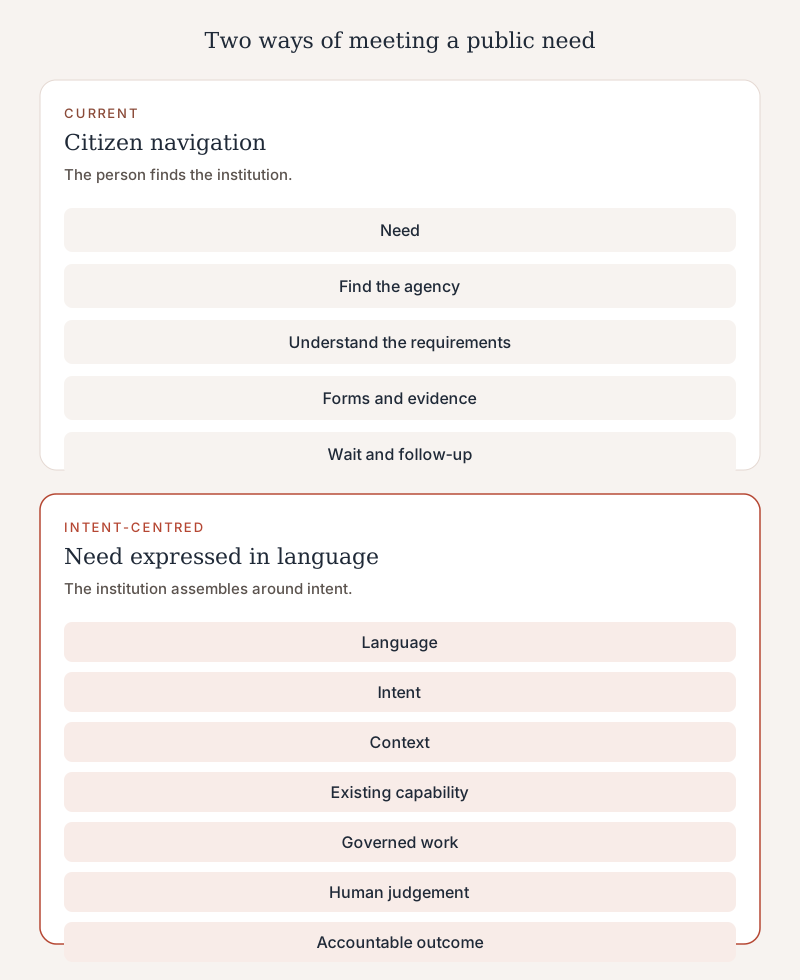
Most public services still begin from the structure of government: departments, programs, portals, forms, schemes and jurisdictions. The citizen is expected to translate a human situation into that structure.
Someone starts with a problem such as: “My mother can no longer look after herself and I need to understand what help is available.” Before getting an answer, they may need to determine which level of government is responsible, which agency owns the service, which programs apply, what evidence is required, and which terminology the institution recognises.
Life does not arrive in administrative categories. Digitisation has often moved the same navigation online. We digitised the institution. We did not necessarily redesign the interaction around the person.
Start with intent, not the institution
Natural language makes a different starting point possible.
Not “Which government service are you looking for?” but “What are you trying to achieve?”
That is more than placing a chatbot on an existing website. A chatbot can make a known service easier to find. The larger opportunity is an interface that can establish intent and then discover which institutional capabilities are relevant to it.
Language is the interface, not the authority. Intent still has to be established clearly enough to assemble context, check what is permitted, and prepare work that can be reviewed.
Government can remain complicated behind that interface. The citizen should not have to experience all of that complexity in order to be helped.
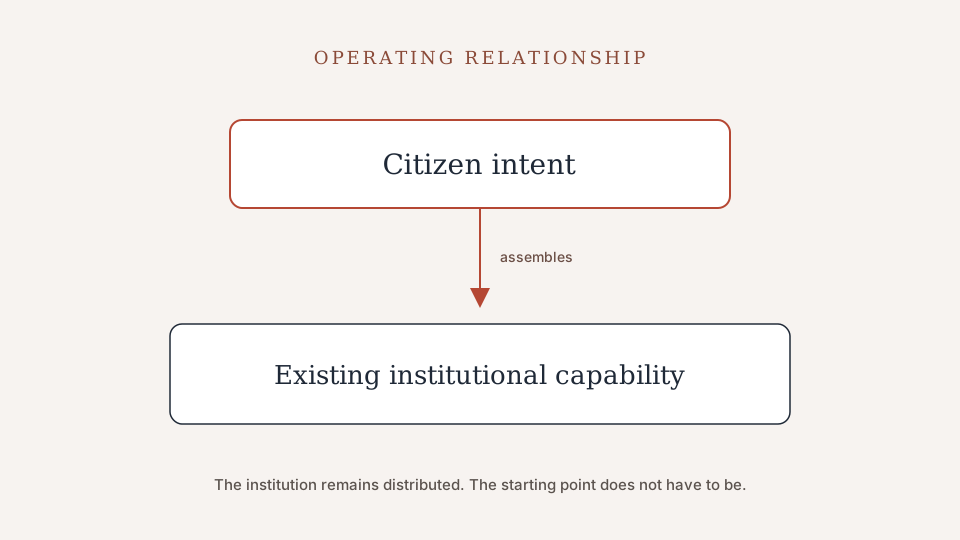
Assemble existing capability around intent
The problem is often not that capability is missing. Governments already have legislation, policy, programs, case-management systems, registers, delegations, digital services and people authorised to decide.
The person needing help is still expected to find and assemble those pieces.
That is an architectural problem of discovery, not a requirement to rebuild the state. Existing systems, knowledge and professional judgement can be assembled around expressed intent rather than requiring the citizen to navigate the organisation chart first.
In DataMPowered terms, this is the operating sequence of Operational Intelligence: language, intent, discovery, establishment, capability assembly, governed work, authorised judgement where required, and an accountable outcome. The model is not the architecture. It is one possible execution mechanism inside wider institutional capability.
Sovereign Operational Intelligence names the institutional implication: knowledge, rules, execution, evidence and judgement should remain under institutional control, not only where a model is hosted.
Structured intent, not generated volume
One of the paper’s more useful observations is that current examples do not generally look like autonomous agents attacking public services. Much of the effect appears to come from something simpler: generative AI has made sophisticated text cheap.
If citizens produce more material, government then spends more effort interpreting that material. Neither side necessarily needs more words. They need a better shared representation of the request.
The useful shift is from an AI-generated document arriving in a queue, toward structured intent: verified context, relevant evidence, applicable rules, the right capability, and a request that the institution can act on.
Natural language can still be how a person explains their circumstances. It does not have to mean unlimited generated prose.
Judgement remains institutional
Making capability easier to reach does not mean allowing a model to exercise public authority.
Interpretation is not authority. Prediction is not judgement. Language generation is not accountability.
A system might help understand what someone is asking, surface relevant policy, assemble permitted information, explain options or route a request. Consequential judgement remains with authorised people—preserved through Judgement Governance—and the institutions that hold that authority.
The path from intent to outcome can be flexible. The accountability around that path cannot be optional. Who had authority, what evidence and rules applied, which capabilities were engaged, and how the result was reached still have to be explainable.
Do not boil the ocean
This does not require replacing every legacy system, standardising every dataset or building one national platform.
Begin with bounded journeys. Reuse what already exists. Let AI interpret language where interpretation helps, search where discovery is needed, and assemble context where context is fragmented. Do not treat the model as the institution. Workflow Discovery is one practical way to begin: bring one real piece of work and examine what institutional capability already exists.
I have been thinking about the interface as a Citizen Workspace: not a chatbot for every department, not an autonomous agent negotiating with the state, and not a live national product. It is an emerging way of describing a persistent working relationship between a person’s intent and the capabilities of the institutions serving them. Continuity around intent matters more than automation. Government systems, authority and accountability may remain distributed. The citizen experience does not necessarily need to be.
AI may be exposing institutional design debt
The authors’ caution about their dataset still matters. Agentic flooding is a glimpse, not a census.
Even so, the pattern is instructive. When the cost of interacting with an institution falls, processes that once required specialist knowledge become easier to attempt. Some of that will be abuse. Some will be noise. Some will be operational pressure. Some may be people finally being able to ask.
If demand was manageable because access was difficult, the weakness was not created by the model. Complexity was being carried by citizens. AI may be exposing that design debt.
From digital government to intent-centred government
The first generation of digital government largely put existing services online. The next may require a different relationship:
From “Here are our services. Find the one that applies to you.”
To “Tell us what you are trying to achieve. We will help determine what capabilities apply.”
That starts with the person rather than the organisation chart. It uses technology to absorb institutional complexity rather than transferring that complexity back to the public. It preserves judgement and accountability rather than assuming that everything capable of being automated should be.
The most important question raised by agentic flooding may therefore not be how governments stop AI from generating too much demand. It may be what government should look like when administrative friction is no longer the thing regulating access.
We can begin with intent. And assemble the institution around it.
References
[1] C. Schmitz, L. Hammond, and A. Chan, “Characterizing Agentic Flooding of Government Services,” arXiv:2608.16603, 2026. https://arxiv.org/abs/2608.16603
This research informs how ifCEM supports governed work, with reviewable workflows designed for accountable adoption in organisations.
Explore ifCEM →Want to discuss how ifCEM could support your organisation? Let's talk.
Start a conversationRelated research
Are We Transforming Around the Wrong Thing?
The opportunity may not be to rebuild organisations around AI, but to make institutional capability easier for people to discover, assemble and use.
We may be treating AI as another enterprise transformation. The opportunity may be a language interface into capability institutions already have.
When Intelligence Accelerates Faster Than Authority
AI does not need to seize control. We may simply keep accelerating the systems we increasingly depend on to decide what comes next.
Capability can outrun the institutions meant to understand, judge and constrain it. An essay on rational dependence, the intelligence–authority relationship, and why better machine judgement does not settle who may decide.
AI Didn't Create the Vulnerability. It Made the Institution Machine-Navigable
Technical debt, workarounds and legacy systems have accumulated for decades. AI is beginning to remove the human friction that made those environments difficult to understand, combine and traverse.
The vulnerability is not new. The cost of discovering, understanding and combining it is changing. Frontier AI reduces the cognitive friction that once limited how quickly institutional weakness could be found and chained together.